 Domains SearchSearch available domain names and claim yours in just a few clicks.
 .GH DomainsFind and register a trusted .gh domain for your business or idea.
 Web HostingAffordable web hosting solutions designed for performance, uptime, and scalability.
 cPanel HostingManage your website without the stress. cPanel hosting gives you everything in one place.
 Reseller HostingCreate, manage, and grow your hosting clients using reliable reseller hosting tools.
 Windows HostingWindows hosting that works smoothly with Microsoft frameworks and applications.
 Email HostingProfessional email hosting that keeps your business communication reliable and secure.
 WordPress HostingFast and secure WordPress hosting optimized for smooth performance and easy management.
 Affiliate ProgramEarn commissions by referring customers to our hosting and domain services.
 .COM Domains
 All DomainsFind the right Ghana domain for your brand and lock it in fast.
 Domain TransferMove your domain to us with a smooth, secure transfer process.
 Whois LookupCheck domain ownership and registration details instantly with our WHOIS lookup.
 SSL CertificatesSecure your website and protect your visitors with trusted SSL certificates.
 VPS HostingUpgrade to VPS hosting today and enjoy better speed, uptime, and flexibility.
 Managed VPSManaged VPS for businesses and developers who want full control without server management worries.
 Dedicated ServersGet maximum speed and reliability with dedicated servers built for serious websites and apps.
 AI Website BuilderStart your website today with our AI builder and go live in minutes.
 Online ShopStart selling online today with your own professional online shop.
 Web Design ServiceProfessional web design services that make your brand stand out online.
 Local SEO
 BlogHelpful articles, tutorials, and updates for building your online presence.
 Contact UsNeed help or more information? Connect with us anytime.
Your domain name is often the very first impression someone forms of your business, sometimes before they’ve even seen your logo or read a single word of your content.
Get it right, and it becomes a quiet asset that builds trust, sticks in people’s memory, and supports your marketing for years.
Get it wrong, and you’ll spend far more time and money down the road trying to rebrand than you would have spent choosing carefully in the first place.
This guide walks through everything that goes into picking a strong domain name: the different types of extensions available, the core factors worth weighing before you commit, the common mistakes that trip up even experienced business owners, and the tools that make the research process much easier.
By the end, you should have a clear, practical framework for making this decision with confidence rather than guesswork.
Factors for Selecting the Best Domain Name
a) Types of Domain Extensions
Before diving into selection strategy, it helps to understand what’s actually available. Domain extensions generally fall into a few categories, and each sends a slightly different signal to visitors.
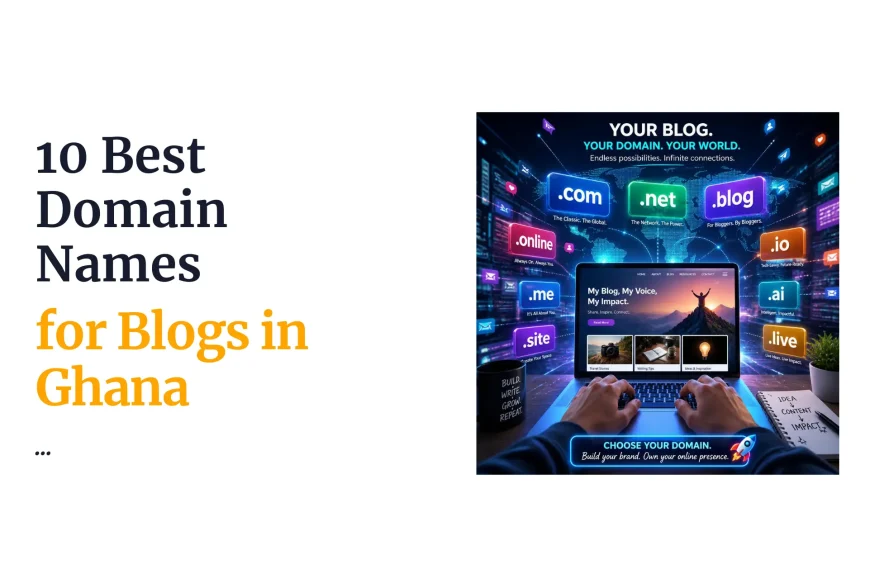
- Common TLDs like .com, .org, and .net remain the most recognized and trusted extensions globally. .com in particular has become so synonymous with “website” that many users will instinctively type it even when a different extension is correct. .org tends to carry a nonprofit or mission-driven association, while .net reads as a general-purpose alternative when your ideal .com name is already taken.
- Newer options such as .blog, .tech, .store, and .app have emerged over the past decade to give businesses more descriptive, purpose-built alternatives. These can work well for niche projects where the extension itself reinforces what the site is about, though they haven’t yet reached the universal recognition that .com enjoys.
- Country-code TLDs (ccTLDs) are tied to a specific nation and signal a local presence. In Ghana, this means extensions like .com.gh, .gh, and .org.gh. These are administered under stricter registration rules than generic extensions, often requiring registrants to have a genuine legal presence in the country, but they pay off with strong local credibility for businesses serving a Ghanaian audience specifically.
- Geographic and industry-specific extensions, such as .nyc for New York-based businesses or .law for legal practices, offer another layer of targeting. These work best when your audience is searching with that specific geography or industry already in mind, since the extension reinforces relevance at a glance.
b) Location and Intent
Before you brainstorm a single name, get clear on who you’re actually trying to reach.
If your business serves a global audience or you want maximum universal recognition, a .com remains the safest default.
But if you’re targeting local people specifically, whether that’s a Ghanaian small business, a service provider working within Accra, or a brand built around serving the domestic market, a .gh or .com.gh extension can do more heavy lifting than a generic .com ever could.
Local extensions build immediate trust with local visitors and can strengthen your visibility in geography-specific search results, something a global extension simply can’t replicate.
c) Relevance to Niche and Content
Your domain name should give visitors an instant, intuitive sense of what your site offers, even before they click through.
A bakery called “Sweet Crumb” makes far more sense as a domain than something abstract and unrelated to food.
This doesn’t mean cramming your exact service into the name (more on that later), but the overall feel and wording should align naturally with your primary topic or service.
It’s also worth thinking carefully about your target audience’s language and terminology.
A term that sounds perfectly natural to you might not match how your actual customers search or talk about your industry.
Spend some time listening to how your audience describes what they’re looking for, and let that inform your naming choices rather than relying purely on internal branding language.
d) Memorability and Ease of Use
A domain name that’s hard to remember is a domain name people won’t come back to, no matter how good your product is.
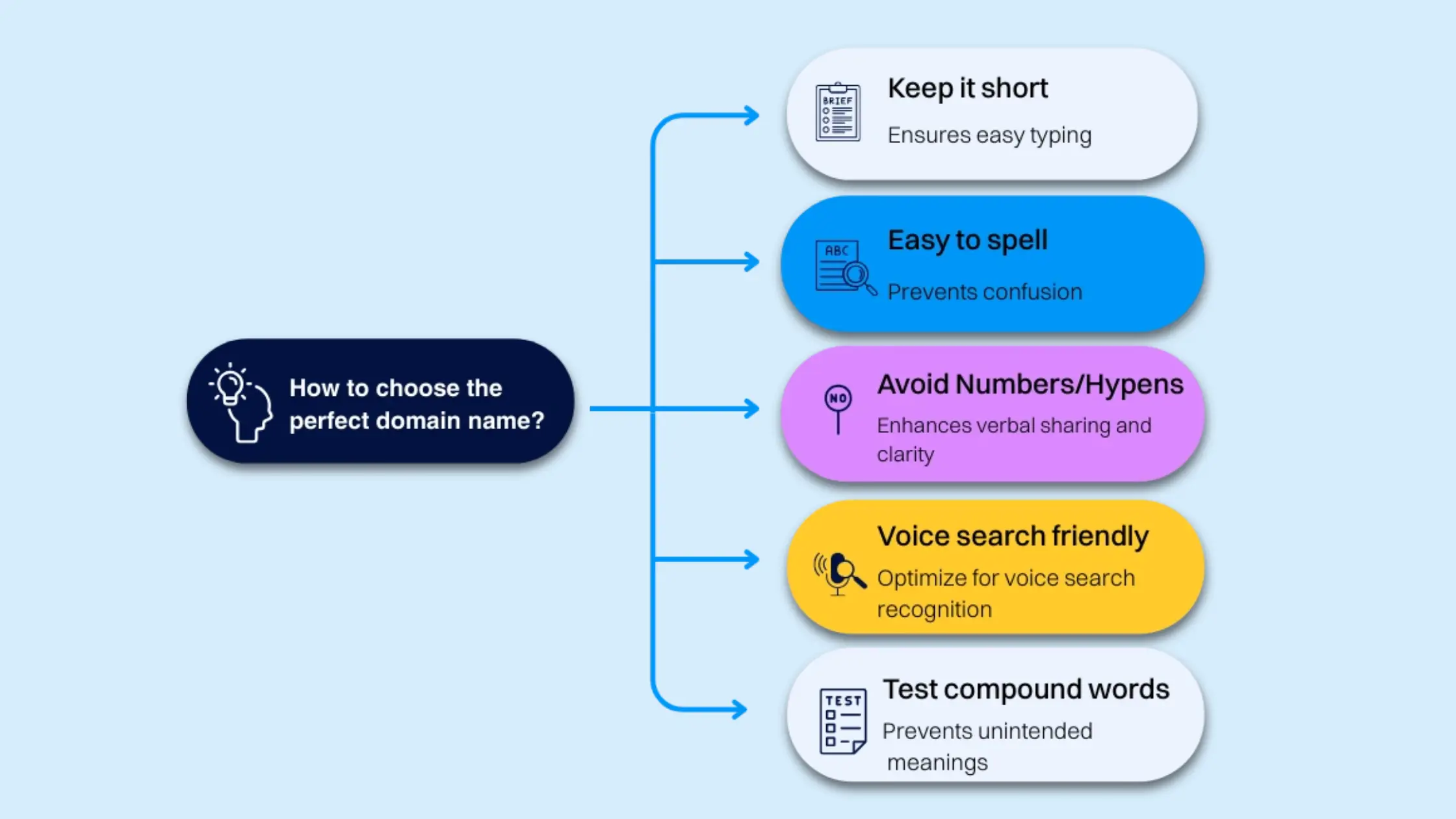
As a general rule, aim to keep your domain under 15 characters.
Shorter names are easier to type correctly, easier to say out loud, and easier to recall days or weeks after someone first encounters your brand.
Pronunciation and spelling simplicity is critical just as much as length.
If someone hears your domain name spoken aloud on a podcast or in conversation, could they type it correctly on the first try?
Avoid names with tricky spellings, unusual letter combinations, or words that could be interpreted multiple ways.
If you find yourself needing to explain how to spell your own domain name regularly, that’s usually a sign it needs rethinking.
e) Brandability and Future Scalability
A great domain name isn’t just descriptive, it’s brandable.
Think about names that could grow into a recognizable identity over time, something people would feel comfortable seeing on a logo, hearing in a radio ad, or mentioning to a friend.
Overly literal or generic names can limit your ability to build a distinctive brand voice later on.
It’s also worth thinking ahead.
If you’re starting with one product or service but expect to expand, avoid boxing yourself into an overly narrow name.
A domain called AccraPhoneRepair.com works well if you’ll only ever fix phones in Accra, but it becomes a liability the moment you expand into laptop repairs or open a second location elsewhere.
A slightly broader, more flexible name often serves growing businesses better in the long run.
f) Technical Aspects
Where possible, prioritize securing the .com version of your name, even if you plan to primarily market under a different extension.
Some businesses register both their preferred extension and the .com version defensively, simply to prevent competitors or bad actors from capturing it later and creating confusion.
Beyond the extension itself, make sure your domain and hosting setup supports SSL certification, which is now considered a baseline requirement for both user trust and search engine ranking.
Most reputable hosting providers include free SSL certificates by default today, but it’s worth confirming before you commit.
Similarly, consider how your domain choice interacts with mobile-friendly design; while the domain name itself doesn’t affect mobile responsiveness directly, choosing a shorter, cleaner name makes for a better experience when users are typing on smaller screens or sharing links via mobile apps.
Common Mistakes to Avoid
Even well-intentioned business owners fall into a handful of predictable traps when choosing a domain name.
- Relying solely on keyword stuffing without brand appeal. Cramming multiple keywords into a domain name might feel like an SEO shortcut, but it usually backfires. These names are hard to remember, look spammy to visitors, and rarely outperform a clean, brandable name paired with genuinely good on-page SEO.
- Ignoring the .com option when it’s critical for credibility. Settling for an alternative extension simply because your first-choice .com was taken can undercut your credibility, particularly with audiences who instinctively trust .com over anything else. Sometimes it’s worth reworking the name itself to secure the .com rather than compromising on the extension.
- Choosing overly complex or trendy names that won’t age well. A name built around a current slang term, a trendy misspelling, or an internet-culture reference might feel clever today, but trends fade quickly. A name designed to age gracefully will serve your brand far longer than one chasing a fleeting moment.
- Skipping a trademark search, leading to legal issues. It’s easy to get excited about an available domain and register it immediately, but failing to check whether the name infringes on an existing trademark can lead to costly disputes, forced rebrands, or even legal action down the line. This step takes minutes and can save you months of headache later.
- Using hyphens or numbers that hinder memorability. Names like best-web-design-2026.com or web4design.com create ambiguity. Does the visitor type the hyphen? Is it the number 4 or the word “for”? These small frictions add up, and they’re entirely avoidable by choosing a cleaner alternative from the start.
Tools and Resources for Domain Research
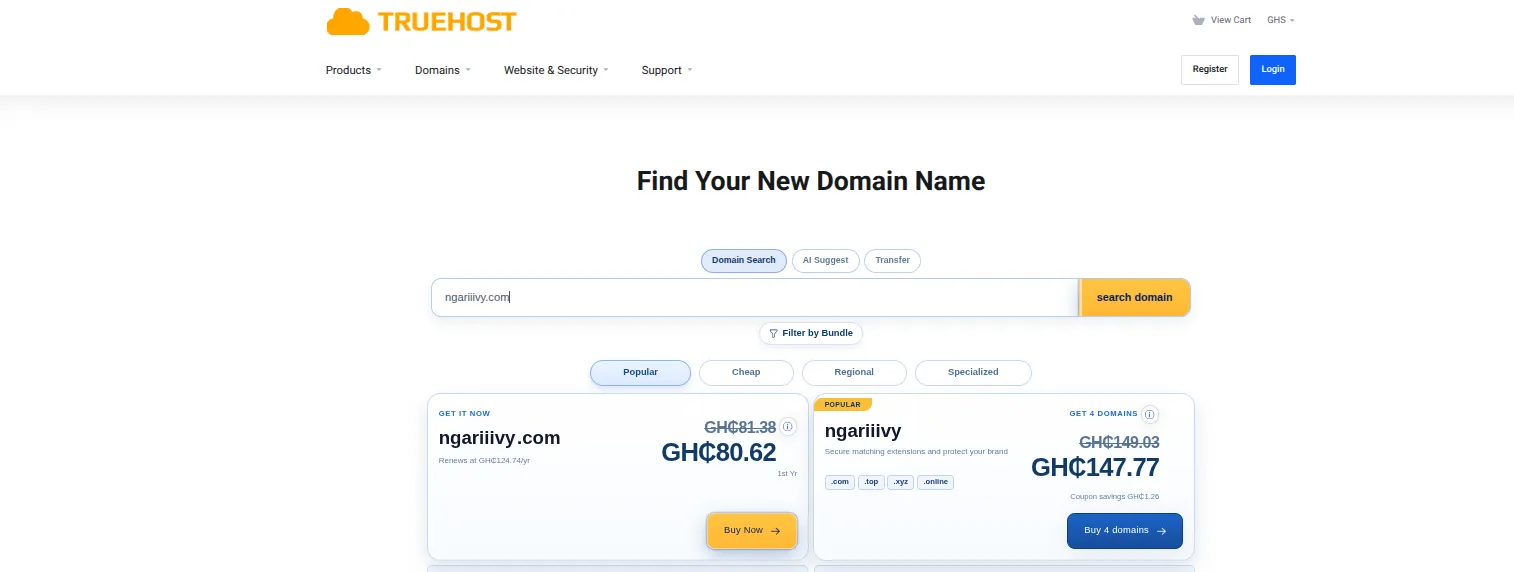
You don’t have to brainstorm and verify everything manually. A handful of tools can speed up the process considerably.
- Domain registrars with built-in search features. Truehost Ghana’s AI-assisted domain search helps surface available names and relevant alternatives quickly, while established registrars like Namecheap and GoDaddy offer similar search tools with suggestions based on your initial query.
- Keyword research platforms. Tools like AnswerThePublic, Ahrefs, and Moz can help you understand how your target audience actually searches for your product or service, giving you language cues that can inform a more relevant, findable domain name.
- Domain name generators and brainstorming tools. When you’re stuck, generator tools can combine root words, prefixes, and suffixes to surface name ideas you might not have considered on your own, which is often enough to break through creative blocks.
- Trademark databases. Checking a name against databases like the USPTO trademark search or Ghana’s national trademark registry before you commit helps you avoid the legal pitfalls mentioned earlier, and it’s a step worth taking even if the domain itself appears available.
- Analytics for checking existing traffic and backlinks. If you’re considering an expired or previously owned domain, tools that reveal its traffic history and backlink profile can tell you whether you’re inheriting a clean slate or a domain with baggage, such as spammy backlinks or a history of penalties from search engines.
Which Domain Name is Best
Choosing the best domain name isn’t a small formality to rush through before the real work of building your website begins, it’s a strategic investment that shapes how people find you, remember you, and trust you from the very first interaction.
The names that perform best over time tend to balance three things: genuine relevance to what you offer, strong memorability, and enough legal and technical soundness to avoid costly surprises later.
Take your time with this decision, but don’t let perfectionism stall you indefinitely either.
Once you’ve weighed the factors covered here, creativity, SEO value, and legal safety, you’ll be in a strong position to make a confident choice.
When you’re ready to move forward, Truehost Ghana offers the search tools, local domain options, and guided registration process to help you put these steps into action and get your ideal domain name secured today.