 Domains SearchSearch available domain names and claim yours in just a few clicks.
 .GH DomainsFind and register a trusted .gh domain for your business or idea.
 Web HostingAffordable web hosting solutions designed for performance, uptime, and scalability.
 cPanel HostingManage your website without the stress. cPanel hosting gives you everything in one place.
 Reseller HostingCreate, manage, and grow your hosting clients using reliable reseller hosting tools.
 Windows HostingWindows hosting that works smoothly with Microsoft frameworks and applications.
 Email HostingProfessional email hosting that keeps your business communication reliable and secure.
 WordPress HostingFast and secure WordPress hosting optimized for smooth performance and easy management.
 Affiliate ProgramEarn commissions by referring customers to our hosting and domain services.
 .COM Domains
 All DomainsFind the right Ghana domain for your brand and lock it in fast.
 Domain TransferMove your domain to us with a smooth, secure transfer process.
 Whois LookupCheck domain ownership and registration details instantly with our WHOIS lookup.
 SSL CertificatesSecure your website and protect your visitors with trusted SSL certificates.
 VPS HostingUpgrade to VPS hosting today and enjoy better speed, uptime, and flexibility.
 Managed VPSManaged VPS for businesses and developers who want full control without server management worries.
 Dedicated ServersGet maximum speed and reliability with dedicated servers built for serious websites and apps.
 AI Website BuilderStart your website today with our AI builder and go live in minutes.
 Online ShopStart selling online today with your own professional online shop.
 Web Design ServiceProfessional web design services that make your brand stand out online.
 Local SEO
 BlogHelpful articles, tutorials, and updates for building your online presence.
 Contact UsNeed help or more information? Connect with us anytime.
Choosing a domain for a blog involves more than just finding a name that’s available.
The extension you pick, the part after the dot, can actually help communicate what your website is about before a visitor even clicks through.
A personal blog, a travel blog, a food blog, a technology blog, a news site, and a creative publication all have slightly different needs, and the right extension can reinforce that identity rather than working against it.
Familiar extensions like .com can genuinely work for almost anything, and that’s exactly why they’ve stayed popular for so long.
But there are now extensions specifically built for blogging and publishing, ones that signal exactly what kind of content lives on the site before a reader reads a single word.
This article walks through 10 of the best domain names for blogs, organized around which extension actually fits which type of blog, rather than declaring one single winner for every situation.
Best Domain Extensions for Blogs at a Glance
| Domain Extension | Best For | What It Communicates |
|---|---|---|
| .blog | General blogs | Clearly identifies the site as a blog |
| .me | Personal blogs | Personal brand or individual creator |
| .life | Lifestyle blogs | Lifestyle, experiences and personal interests |
| .travel | Travel blogs | Travel content and destinations |
| .food | Food blogs | Recipes, restaurants and food content |
| .tips | Advice blogs | Tips, guides and educational content |
| .news | News/blog publications | News and current affairs |
| .tech | Technology blogs | Technology and digital topics |
| .online | General online publications | Broad online presence |
| .site | General blogs/websites | Flexible alternative for many blog types |
It’s worth noting that availability varies by name, not every extension will be available for every domain you want, so treat this list as a guide to which extension fits your blog’s identity, and check availability directly when you’re ready to register.
1) .blog
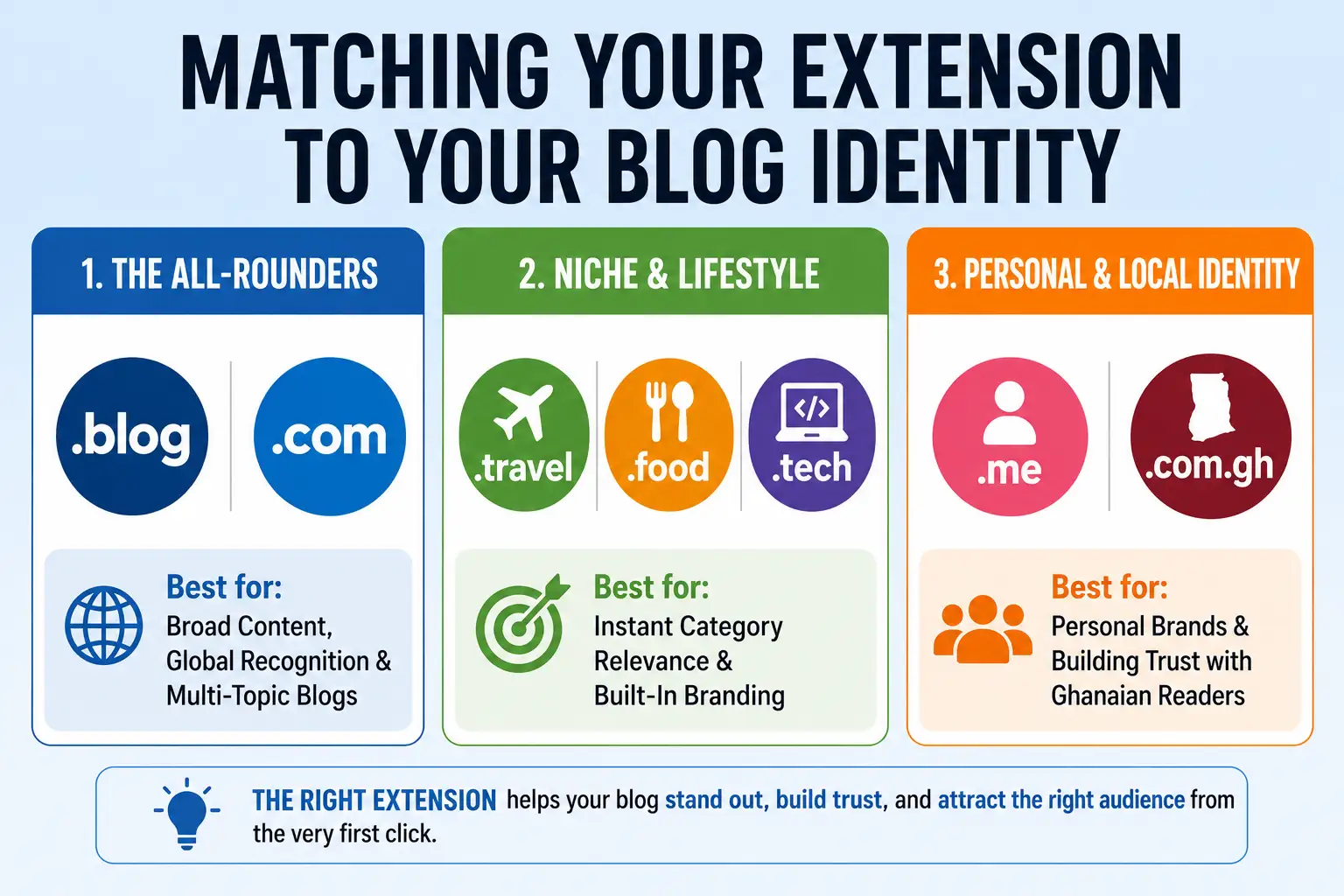
This is probably the clearest general-purpose choice on this whole list, since .blog was specifically created for exactly this purpose.
It works well across a genuinely wide range of blogging use cases.
Personal blogs benefit from the immediate clarity it provides, visitors know exactly what they’re getting the moment they see the domain.
Professional blogs and company blogs use it to separate their content hub from their main business site while keeping the connection obvious.
Niche publications and online magazines find it useful for signaling a content-first identity rather than a product or service one.
And individual content creators building a personal following often gravitate toward .blog specifically because it doubles as both a domain and a statement of purpose.
Because .blog is unmistakably tied to blogging, it can also help set reader expectations from the very first glance at a URL, before a single headline or image has loaded.
That clarity is genuinely useful when you’re trying to build an audience from scratch, since there’s no ambiguity about what kind of site someone’s about to land on.
2) .me
.me positions itself naturally as one of the best domain names for blogs built around a personal brand rather than a broader publication.
- It suits personal journals where the writing itself is the focus,
- career blogs documenting a professional journey,
- portfolio blogs showcasing creative or professional work,
- creator websites built around an individual’s presence,
- personal development blogs sharing growth and reflection,
- and professional writers who want a domain that reads like a signature rather than a generic web address.
The extension itself reads almost like a personal pronoun, which is exactly why it works so well for anything centered on one individual voice.
3) .life
.life is a natural fit for lifestyle-focused blogs that don’t want to be boxed into one narrow subject.
It suits general lifestyle content, wellness blogs, blogs built around sharing personal experiences, parenting blogs, fashion content, relationship writing, everyday living topics, and personal development blogs that touch on multiple areas of life rather than just one.
What makes .life particularly useful is its flexibility, it reinforces the overall theme of a lifestyle blog without locking the site into one narrow subject the way a more specific extension might.
A blogger writing about parenting one week and fashion the next isn’t fighting against their domain the way they might with something more rigidly defined.
4) .travel
For travel bloggers specifically, .travel is about as obvious a fit as extensions get.
It works well for travel guides walking readers through specific destinations, destination-focused blogs built around one region or country, travel diaries chronicling a personal journey, tourism-focused content, travel photography portfolios, and adventure blogs documenting more active or off-the-beaten-path travel.
A domain like ghanatravels.travel or similar immediately tells a visitor exactly what they’re about to read, which can genuinely help with both memorability and first impressions.
5) .food
Food bloggers, recipe creators, and culinary websites have a genuinely strong option in .food.
It suits recipe blogs sharing step-by-step cooking instructions, restaurant review sites, food photography portfolios, general cooking blogs, baking-specific content, and blogs exploring the intersection of food and culture.
A niche extension like this can make a domain considerably more memorable specifically when it naturally matches the website’s actual subject, since the extension itself becomes part of the branding rather than just a technical afterthought tacked onto the end of a name.
6) .tips
.tips works well for blogs built specifically around advice and genuinely useful, actionable information.
This covers how-to blogs walking readers through specific processes, tutorial-focused sites, general life advice content, business advice blogs, DIY project blogs, educational content more broadly, and technology tips sites specifically.
The extension itself sets an expectation before a visitor even reaches the homepage, they’re arriving expecting practical, useful takeaways rather than personal storytelling or entertainment.
7) .news
.news can work well for blogs that function more like genuine publications than personal journals.
This includes news websites covering current events, current affairs commentary, industry-specific publications, local news coverage, entertainment news, and sports news specifically.
One important distinction worth being clear about here: a blog doesn’t need to use .news simply because it publishes frequently or covers timely topics.
It’s most appropriate specifically when the site’s actual content is news-oriented in nature, reporting, commentary on current events, or industry updates, rather than just being updated regularly.
8) .tech
.tech is a genuinely strong option for anything technology-focused.
This covers software blogs, AI-focused content, gadget review sites, web development blogs, hosting and infrastructure-focused content, cybersecurity writing, and blogs covering startups and broader technology news.
For Ghanaian bloggers writing about the growing tech and digital space specifically, .tech offers an extension that immediately signals credibility and relevance within that niche, standing out clearly from more generic extensions that don’t carry the same built-in context.
9) .com
.com remains the most globally recognized extension in existence, and it’s worth including here precisely because familiarity still counts for a lot.
A .com domain works for genuinely any type of blog, personal, lifestyle, travel, food, tech, or anything else, without needing to explain itself.
Its main strength is universal recognition: most readers, regardless of where they’re from, immediately recognize what a .com domain represents, and that familiarity can lend a blog a sense of established credibility right from the first impression.
10) .com.gh
For bloggers specifically building an audience within Ghana, .com.gh offers something .com can’t: an immediate, unmistakable local identity.
This extension signals directly to Ghanaian readers that the blog is locally rooted, which can build trust faster with a local audience and help the site stand out specifically within Ghana-focused search results and local directories.
It’s a strong option for bloggers whose content, audience, or brand identity is specifically tied to Ghana rather than aiming for a purely international readership.
Other Domain Extensions Worth Considering
A handful of other extensions don’t necessarily deserve their own full section, but they’re worth knowing about as alternatives depending on your specific brand or preferred domain name.
- .online works well for general-purpose blogs and broader online publications that don’t fit neatly into one niche category.
- .digital suits blogs focused on digital marketing, technology, or online business content specifically.
- .space can work nicely for creative, community-driven, or personal blogs looking for something a little less conventional than the more established extensions.
- .world fits naturally for travel content, blogs covering international topics, or broad-interest publications not tied to one specific country or region.
None of these are necessarily better than .blog as a default choice.
They’re genuine alternatives that might fit a particular brand name or creative direction better, especially if your preferred name is already taken under a more common extension.
Tips for Choosing a Domain Name for Your Blog
1) Keep It Easy to Remember
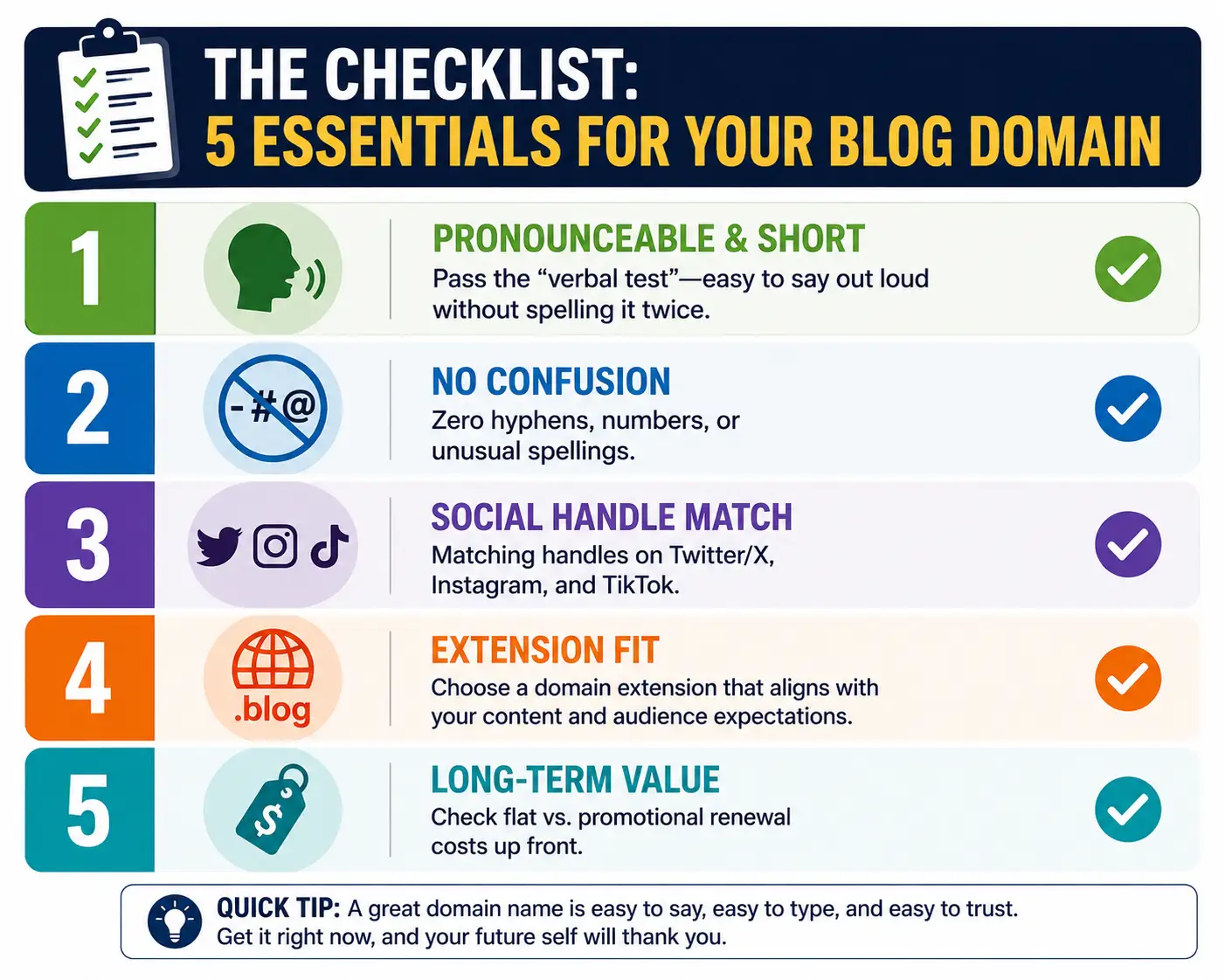
Choose a name readers can recall after seeing or hearing it once. A simple, memorable domain is also easier to share through word of mouth.
2) Keep the Name Short
Avoid long domain names that are difficult to type, spell, or say aloud. The shorter and cleaner it is, the easier it is for readers to use.
3) Avoid Confusing Spellings
Skip unusual spellings, excessive hyphens, and number substitutions such as replacing “for” with “4.” If people aren’t sure how to type your domain, they’ll have a harder time finding you.
4) Leave Room to Grow
Don’t make your domain so specific that you’re stuck with one topic forever. For example, a name built entirely around smartphone reviews could become limiting if you later expand into laptops, apps, or other technology topics.
5) Match Your Blog’s Niche
Your domain should give visitors some sense of what your blog is about while fitting the tone and personality of your content.
6) Check Social Media Availability
If you want consistent branding across your blog and social channels, check whether the same or a similar username is available on the platforms you plan to use.
7) Check for Trademark Conflicts
Before registering a domain, search for existing businesses and trademarks using the same or a confusingly similar name. This can help you avoid expensive branding or legal problems later.
8) Choose an Extension That Fits
Don’t automatically choose .com just because it’s familiar. Consider whether a more specific extension makes sense for your blog and its audience.
9) Look Beyond the First-Year Price
Check the renewal price before registering. Some domain extensions have attractive first-year offers but cost considerably more to renew, so consider the long-term cost rather than just the introductory price.
Which Domain Extension Should You Choose for Your Blog?
There isn’t one universally correct answer here.
And among these options, .blog remains the clearest general-purpose choice for most bloggers, since it communicates exactly what the site is without any ambiguity.
- .me works particularly well for personal brands built around one individual voice.
- .life suits broad lifestyle content that doesn’t sit neatly in one category.
- .travel and .food work naturally and obviously for those specific niches.
- .tips fits advice-driven, educational blogs well.
- .news makes sense specifically for genuinely news-focused publications.
- And .tech is a natural fit for anything covering technology, software, or the digital space.
Ultimately, the best domain names for blogs are the ones that match both your content and your audience’s expectations.
If you’re ready to find yours, Truehost Ghana lets you search and compare available extensions, including .blog, .me, .tech, .com, and .com.gh, so you can register the one that genuinely fits your blog and get writing.