 Domains SearchSearch available domain names and claim yours in just a few clicks.
 .GH DomainsFind and register a trusted .gh domain for your business or idea.
 Web HostingAffordable web hosting solutions designed for performance, uptime, and scalability.
 cPanel HostingManage your website without the stress. cPanel hosting gives you everything in one place.
 Reseller HostingCreate, manage, and grow your hosting clients using reliable reseller hosting tools.
 Windows HostingWindows hosting that works smoothly with Microsoft frameworks and applications.
 Email HostingProfessional email hosting that keeps your business communication reliable and secure.
 WordPress HostingFast and secure WordPress hosting optimized for smooth performance and easy management.
 Affiliate ProgramEarn commissions by referring customers to our hosting and domain services.
 .COM Domains
 All DomainsFind the right Ghana domain for your brand and lock it in fast.
 Domain TransferMove your domain to us with a smooth, secure transfer process.
 Whois LookupCheck domain ownership and registration details instantly with our WHOIS lookup.
 SSL CertificatesSecure your website and protect your visitors with trusted SSL certificates.
 VPS HostingUpgrade to VPS hosting today and enjoy better speed, uptime, and flexibility.
 Managed VPSManaged VPS for businesses and developers who want full control without server management worries.
 Dedicated ServersGet maximum speed and reliability with dedicated servers built for serious websites and apps.
 AI Website BuilderStart your website today with our AI builder and go live in minutes.
 Online ShopStart selling online today with your own professional online shop.
 Web Design ServiceProfessional web design services that make your brand stand out online.
 Local SEO
 BlogHelpful articles, tutorials, and updates for building your online presence.
 Contact UsNeed help or more information? Connect with us anytime.
Does a domain name affect SEO? Short answer, yes, but probably not in the way you’re picturing right now.
The domain name itself is generally not a major direct ranking factor.
Google isn’t quietly handing out ranking points because your domain contains a particular keyword, or because you paid extra for a premium name, or because your domain happens to be fifteen years old.
But that’s not the whole story either.
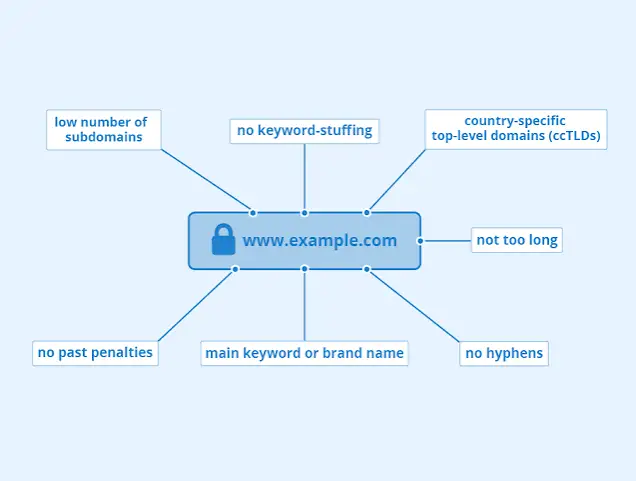
Things associated with your domain, relevance, branding, user trust, its history, how redirects are handled, and even the extension you choose, can influence SEO indirectly, or shape how easily your site builds visibility over time.
So the honest answer sits somewhere between the two extremes people usually argue about online.
This article breaks down exactly which domain-related factors actually affect, which ones are myths that refuse to die, and what genuinely drives rankings instead.
Does a Domain Name Affect SEO?
Let’s separate this into two distinct questions, because conflating them is where most of the confusion starts.
a) Domain Name as a Direct Ranking Factor
Google doesn’t rank a website higher simply because its domain contains a particular keyword.
This used to be somewhat different, exact-match domains had a real, if modest, advantage in the early 2010s, which led to a flood of low-quality sites buying keyword-stuffed domains purely to game rankings.
Google’s EMD update in 2012 specifically targeted that behaviour, and the advantage has continued shrinking ever since.
Having an exact-match keyword in your domain today doesn’t guarantee anything close to a ranking boost, and a strong, catchy domain name can’t compensate for poor content, weak technical SEO, or a site with no real authority behind it.
If the underlying website doesn’t satisfy what searchers are actually looking for, no domain name is going to rescue it.
b) How Your Domain Can Affect SEO Indirectly
This is where the real nuance lives, and it’s worth taking seriously rather than dismissing outright.
A well-chosen domain supports brand recognition, which matters more than people give it credit for.
A short, clear, memorable name is easier for people to recall, type correctly, and mention when recommending your site to someone else.
That memorability feeds into click-through behavior too, a domain that looks trustworthy and relevant in a list of search results tends to earn more clicks than one that looks spammy or confusing, and click-through rate is something search engines do pay attention to as a usage signal.
User trust plays a similar role, visitors are naturally more cautious about clicking through to something that looks like a random string of keywords crammed together versus a name that reads like an actual business.
Domains also shape link acquisition in subtle ways.
People are simply more likely to link to and mention a brand they recognise and trust, and organic brand mentions and backlinks are genuinely valuable ranking signals, even though the domain name isn’t the thing being rewarded directly.
Consistent brand mentions across the web, on social media, in press coverage, in casual conversation, reinforce that same trust signal over time.
The distinction to hold onto here is that the domain isn’t handing you ranking points directly.
But the choices you make around it, how memorable it is, how trustworthy it looks, how consistently you use it, can absolutely influence your SEO performance over the long run.
What Actually Affects SEO?
Here’s the clearest way to put it: your domain name is not a major factor that determines where your website ranks in Google.
Choosing a keyword-rich domain, buying an older domain, or paying a premium for a better name does not automatically improve your rankings.
Search engines weigh a huge number of other signals when deciding which pages deserve to show up in search results, and that’s really where your attention should go instead.
A) High-Quality, Relevant Content
This is genuinely the biggest lever you have, so it’s worth spending the most time on.
Google needs to understand whether a given page actually satisfies what someone searching for it is looking for, and that comes down to several things working together.
Relevance to search intent is very key, a page needs to answer the actual question being asked, not just circle around a topic.
Original, useful information beats content that simply repeats what’s already ranking, since search engines are increasingly good at recognising recycled material.
Comprehensive coverage helps where the topic calls for it, though padding a page with unnecessary length just to look thorough tends to backfire.
Accuracy is critical too, factually wrong or outdated information erodes trust fast, both with readers and with search engines evaluating your site’s overall quality.
And above everything else, content genuinely written for people, rather than stuffed with keywords aimed at an algorithm, consistently performs better, because that’s ultimately what search engines are trying to identify and reward.
B) Backlinks and Website Authority
Links from other reputable, relevant websites help establish that your site is a credible source worth trusting.
But this isn’t a numbers game, quality matters far more than simply accumulating as many links as possible.
A handful of links from genuinely authoritative, topically relevant sites will do more for you than hundreds of low-quality links from unrelated directories or spammy sites.
This is also where we can put the “old domain equals automatic SEO advantage” myth to rest properly.
A domain doesn’t become authoritative just because it’s been registered for a long time, what actually affects SEO is what’s been built on it, the content published, the links earned, and the trust accumulated over that period.
An old, neglected domain with no real link profile holds no inherent advantage over a new one.
C) Technical SEO
This is the foundation that lets Google actually crawl, understand, and index your website in the first place, and it’s easy to overlook since none of it is visible to visitors.
Crawlability determines whether search engines can even reach your pages, and proper indexing ensures those pages actually make it into the search results.
XML sitemaps help search engines discover your content efficiently, especially on larger sites, while canonical URLs prevent duplicate content issues from splitting your ranking signals across multiple versions of the same page.
Structured data, where relevant, helps search engines understand context and can unlock richer search result features.
Proper redirects matter too, especially if you ever change URLs or migrate domains, since broken redirect chains can quietly tank pages that were previously ranking well.
A clean robots.txt file makes sure you’re not accidentally blocking search engines from content you actually want indexed.
And HTTPS belongs here as well, it’s been a baseline expectation for years now, less a competitive advantage and more something you’ll be penalised for lacking.
D) Page Experience and Website Performance
A great domain name means nothing if the site behind it is slow or frustrating to use.
Page speed affects both user experience and how search engines evaluate a site’s quality, and Core Web Vitals specifically measure loading performance, interactivity, and visual stability in ways Google actively factors into its assessment.
Mobile usability is non-negotiable at this point, given how much search traffic comes from phones.
Responsive design that adapts properly across screen sizes, rather than a desktop site awkwardly squeezed onto mobile, makes a measurable difference.
Intrusive elements, think pop-ups that block content the moment someone lands on a page, actively hurt the experience and can work against you.
Overall usability ties all of this together, a site that’s easy to navigate and quick to use keeps people around, which reflects well on the page in ways that compound over time.
E) Search Intent and Keyword Relevance
This is where the keyword-in-domain misconception deserves a closer, more balanced look rather than being dismissed too quickly.
Using the right keywords in your content genuinely helps Google understand what a page is actually about, that part hasn’t changed.
What has changed is where that signal carries the most weight, and it isn’t the domain.
Matching what the searcher actually intends to find is key far more than whether your domain happens to contain the term they typed.
An exact-match domain like bestplumbersinghana.com doesn’t automatically outrank a branded domain like acmeplumbing.com, what determines the outcome is which site better satisfies the search and builds stronger overall signals elsewhere.
Where you place keywords on the website itself matters considerably more than whether they appear in the domain.
That includes your page titles, main headings, the body content itself, your URLs, image alt text where it’s genuinely descriptive, and the anchor text used in internal links.
All of these carry real weight that a keyword sitting in your domain name simply doesn’t.
F) Internal Linking and Site Structure
Internal links help search engines discover new pages and understand how different pieces of content on your site relate to one another.
Linking relevant pages together, maintaining logical navigation, using descriptive anchor text instead of generic “click here” phrasing, and keeping a clear site hierarchy all give search engines a much better map of your site’s structure and priorities.
This is another area that delivers far more practical SEO value than agonising over the perfect domain name ever will.
G) Mobile-Friendliness
Google primarily uses the mobile version of your site for indexing and ranking, a practice known as mobile-first indexing.
That means your website genuinely needs to function properly across phones and tablets, not just look acceptable on a desktop monitor.
If your mobile experience is broken, slow, or missing content that exists on desktop, that’s what Google is largely evaluating, regardless of how polished the desktop version looks.
H) Local Relevance
For businesses targeting customers in Ghana specifically, local SEO brings in a different set of signals worth knowing on their own terms.
Business location is important, along with a properly optimised Google Business Profile, since that’s often the first thing local searchers encounter.
Local citations, consistent mentions of your business name, address, and phone number across relevant directories, reinforce credibility.
Locally relevant content, genuine customer reviews, and dedicated location-specific pages for businesses serving multiple areas all contribute meaningfully here.
Keeping your business information consistent everywhere it appears online rounds this out.
Where the domain extension fits into this picture deserves a clear, accurate answer rather than an overstated one.
A .gh domain can reinforce a Ghanaian identity and may help build local trust with visitors who recognise it, but simply choosing .gh does not guarantee better rankings within Ghana.
It’s a branding and trust signal, not a ranking shortcut.
I) Website Reputation and Spam Signals
Google actively watches for practices that suggest a site is trying to manipulate rankings rather than earn them.
Manipulative link-building schemes, keyword stuffing, automatically generated low-quality content, cloaking (showing search engines different content than what visitors actually see), and malware or other security problems all damage a site’s reputation with search engines, sometimes severely.
This is also where domain history genuinely can matter, though not in the way the “old domain” myth suggests.
If you buy a previously used domain, it’s worth investigating its history, since a domain that was previously penalised for spam or associated with malicious activity can carry that baggage forward.
But that’s a risk-management issue tied to a specific domain’s past, not a general rule that old domains carry some inherent SEO advantage over new ones.
J) User Engagement and Satisfaction
It’s worth being careful with this one rather than reaching for oversimplified claims like Google ranks pages with high dwell time.
The reality is broader and harder to reduce to a single metric.
What counts is whether a page genuinely satisfies the query someone typed in, whether visitors can actually find what they came looking for, whether the content is easy to use once they’re on the page, and whether the overall experience feels good rather than frustrating.
Individual metrics like bounce rate or time on page aren’t straightforward, isolated ranking factors the way some SEO content suggests.
They’re more like symptoms of the underlying quality (or lack of it) that search engines are trying to assess through many different signals at once.
Does Your Domain Name Really Count for SEO?
Bringing this back to where we started: yes, your domain can affect SEO, but it isn’t a shortcut to higher rankings.
And it never really was one, even in the earlier days of search when exact-match domains carried slightly more direct weight.
The biggest impact on where you rank comes from the website’s actual content, its technical SEO foundation, how well it performs for real visitors, the backlinks and authority it earns over time, the overall user experience, how well it matches search intent, and the general quality of the site as a whole.
The domain mainly counts through relevance, branding, geographic targeting for local businesses, the trust it builds with visitors, its history if you’re buying an existing one, and the practical consequences of changing domains down the line, since migrations can temporarily disrupt rankings if redirects aren’t handled properly.
If you’re setting up or growing a website in Ghana, picking a domain that reflects your brand clearly, alongside reliable hosting that keeps your site fast and available, gives you a solid foundation to build everything else on top of.
Truehost Ghana offers domain registration and hosting together, so you can register something memorable and get your site online without juggling separate providers for each piece.
Frequently Asked Questions
Does a domain name affect SEO?
Indirectly, yes. It’s not a major direct ranking factor, but the trust, branding, and click-through behaviour associated with a good domain name can support your broader SEO efforts over time.
Does having keywords in your domain help SEO?
Not in any meaningful direct way. Keyword-stuffed domains lost most of their advantage after Google’s 2012 EMD update, and today, relevance and quality within your actual content matter far more than what’s in the domain name.
Does .com rank better than .gh?
No, the extension itself isn’t a ranking factor. A .gh domain can help reinforce local identity and trust for Ghanaian audiences, while .com tends to suit businesses aiming for a more international reach, but neither one ranks higher purely because of the extension.
Is .gh good for SEO in Ghana?
It can support local branding and trust for a Ghana-focused business, but it doesn’t guarantee better rankings on its own. Local SEO success still depends far more on your Google Business Profile, local citations, and locally relevant content.
Does domain age affect Google rankings?
Not directly. What often gets mistaken for a domain-age advantage is actually the accumulated content, backlinks, and trust an older domain has built up over time, not the registration date itself.
Does changing a domain name hurt SEO?
It can, temporarily, if the migration isn’t handled carefully. Proper 301 redirects from every old URL to its new equivalent, along with updated internal links and sitemaps, are essential to preserving your existing rankings through a domain change.
Can an old domain help SEO?
Only if it comes with genuine value attached, existing backlinks, established authority, or relevant content history. An old domain with no real history behind it offers no inherent advantage over registering a brand new one.
Does HTTPS affect SEO?
Yes, HTTPS is considered a baseline technical requirement at this point. Sites without it can face a disadvantage, though having HTTPS alone won’t boost rankings, it’s more about avoiding the downside of not having it.
Should my domain name match my business name?
Generally, yes, it helps with brand recognition and makes your site easier for people to find and remember. It’s not an SEO requirement, but it does support the broader trust and branding factors that indirectly help.
Are exact-match domains good for SEO?
Not particularly anymore. They carried more weight years ago, but today a branded, memorable domain paired with strong content and authority will outperform a purely keyword-matched one in most cases.
Can a bad domain name hurt Google rankings?
Not directly through some ranking penalty, but a confusing, hard-to-trust, or spammy-looking domain can hurt click-through rates and user trust, which indirectly affects the broader signals search engines do consider.