 Domains SearchSearch available domain names and claim yours in just a few clicks.
 .GH DomainsFind and register a trusted .gh domain for your business or idea.
 Web HostingAffordable web hosting solutions designed for performance, uptime, and scalability.
 cPanel HostingManage your website without the stress. cPanel hosting gives you everything in one place.
 Reseller HostingCreate, manage, and grow your hosting clients using reliable reseller hosting tools.
 Windows HostingWindows hosting that works smoothly with Microsoft frameworks and applications.
 Email HostingProfessional email hosting that keeps your business communication reliable and secure.
 WordPress HostingFast and secure WordPress hosting optimized for smooth performance and easy management.
 Affiliate ProgramEarn commissions by referring customers to our hosting and domain services.
 .COM Domains
 All DomainsFind the right Ghana domain for your brand and lock it in fast.
 Domain TransferMove your domain to us with a smooth, secure transfer process.
 Whois LookupCheck domain ownership and registration details instantly with our WHOIS lookup.
 SSL CertificatesSecure your website and protect your visitors with trusted SSL certificates.
 VPS HostingUpgrade to VPS hosting today and enjoy better speed, uptime, and flexibility.
 Managed VPSManaged VPS for businesses and developers who want full control without server management worries.
 Dedicated ServersGet maximum speed and reliability with dedicated servers built for serious websites and apps.
 AI Website BuilderStart your website today with our AI builder and go live in minutes.
 Online ShopStart selling online today with your own professional online shop.
 Web Design ServiceProfessional web design services that make your brand stand out online.
 Local SEO
 BlogHelpful articles, tutorials, and updates for building your online presence.
 Contact UsNeed help or more information? Connect with us anytime.
Every website begins with a name.
Before any page loads, before any images appear, before any words are read, there is a name sitting quietly in the background.
Most of us use domain names every single day without stopping to wonder what they actually are.
We type them, click them, share them, and move on.
But the moment someone pauses to ask about domain name meaning, they are usually looking for something very simple.
They want to know what a domain name really is, what role it plays, and why the internet depends on it so heavily.
Let’s walk through it slowly and clearly.
What Is the Meaning of a Domain Name?
A domain name is the name used to identify a website on the internet.
Behind every website is a numerical address called an IP address.
These numbers help computers locate each other, but they are not easy for people to remember.
A domain name replaces those numbers with words and letters that humans can use comfortably.
For example, instead of typing something like 196.1.45.22, you type a name such as example.com.gh.
That name points to the correct location where the website is stored.
The global system that manages domain names is coordinated by ICANN, which ensures every domain name works correctly and points to the right place on the internet.
Why Domain Names Exist at All
The internet was not always easy to use.
In the early days, websites were accessed using numbers only.
As more sites appeared, this became confusing very quickly. Domain names were introduced to make access simpler and more organized.
Instead of memorizing numbers, people could remember names.
That single change made the internet usable for everyone, including businesses, schools, and everyday users in Ghana and beyond.
How Domain Names Work Behind the Scenes
When someone types a domain name into a browser, several things happen almost instantly.
First, the browser checks the Domain Name System (DNS). The DNS acts like a directory.
It matches the domain name to its numerical IP address.
Once the match is found, the browser is sent to the correct server, and the website loads.
All of this happens in seconds, without the user needing to do anything extra.
This system is standardized globally, which means a domain name registered in Ghana works the same way as one registered anywhere else in the world.
Parts of a Domain Name
To fully get the domain name meaning, it helps to break a domain into its parts.
Let’s use this example:
blog.mywebsite.com.gh
Each part has a specific role.
Subdomain
In the example above this is the blog section.
The subdomain appears at the beginning. It is optional and is used to organize content within a website.
Common subdomains include:
wwwblogmailSupportshop
A subdomain does not change the main identity of the domain. It simply points to a section under it.
Second-Level Domain
Example: mywebsite
This is the main name chosen by the owner.
It is the most recognizable part of the domain and usually reflects a brand name, business name, or personal name.
For example, if your physical shop is named Akwaaba Mart, your second-level domain for your website would be akwaabamart.
When people talk about registering a domain name, this is the part they are selecting.
Top-Level Domain (TLD)
E.g: .com.gh
This is the extension at the end of the domain. It shows the category or country associated with the name.
In Ghana, common extensions include:
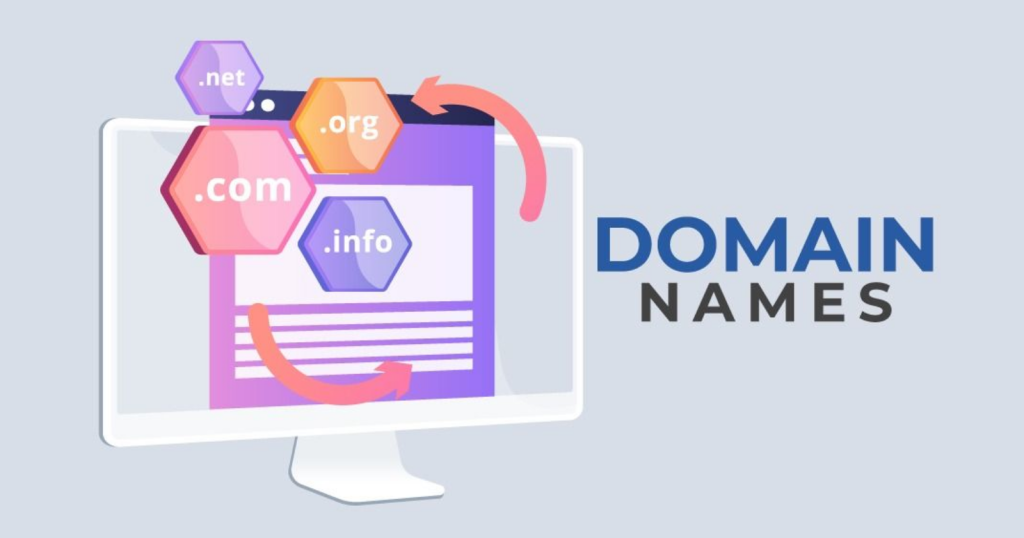
- .com.gh
- .org.gh
- .edu.gh
- .gov.gh
These extensions place the domain inside Ghana’s internet space while still being part of the global system coordinated by ICANN.
At this point, if you are exploring domain names or checking what is available under .gh, you can browse and register them directly through Truehost Domains.
Domain Names and Ghana’s Internet Space
Every country has its own space on the internet, and for Ghana, that space is represented by .gh.
The .gh extension is Ghana’s country-code top-level domain.
When a domain name ends with .gh, it immediately shows a connection to Ghana.
It tells users, browsers, and internet systems that the website is linked to the country, either through location, audience, or registration.
Across Ghana, businesses, institutions, and individuals use .gh domain names to establish an online identity that feels local and familiar.
From company websites to schools, non-profits, and personal projects, the .gh extension has become a clear marker of Ghana’s presence on the internet.
Behind the scenes, all .gh domain names are managed by the Ghana Domain Name Registry (GNDNR).
GNDNR is responsible for overseeing registrations, maintaining standards, and ensuring that .gh domains operate smoothly within the global domain name system.
Even though .gh is Ghana-specific, it follows the same international rules as other domain extensions worldwide.
These rules are coordinated under ICANN, which ensures that domain names resolve correctly, remain unique, and work consistently no matter where someone is accessing the internet from.
What this means in simple terms is that a .gh domain works just like any other domain name.
It can be typed into a browser, linked from anywhere, and accessed globally.
The only difference is the ending, which places it clearly within Ghana’s online space.
So when you see a website ending in .gh, you are not just looking at an address.
You are looking at a domain name that sits inside Ghana’s official corner of the internet, connected locally but accessible worldwide.
Frequently Asked Questions About Domain Name Meaning
What does a domain name actually do?
A domain name acts as a bridge between people and websites. When someone types a domain name into a browser, it directs that request to the correct server where the website is stored.
This happens through the Domain Name System (DNS), which matches the name to its numerical address behind the scenes. Without domain names, users would need to enter long strings of numbers to reach websites.
Is a domain name the same worldwide?
Yes. Domain names work the same way everywhere in the world. The rules that govern them are coordinated globally by ICANN, which ensures that domain names are unique and function consistently.
While extensions like .gh represent specific countries, the technical system behind them follows the same global standards.
Can one website have more than one domain name?
Yes, a single website can be connected to multiple domain names. When this is set up correctly, all those names point to the same website location.
Even though the website content stays the same, each domain name remains a separate, unique address within the internet system.
What makes a domain name unique?
A domain name is unique because no two identical names can exist under the same extension.
For example, once a name is registered under .com.gh, no one else can register that exact same name with the same ending. This uniqueness is enforced through the global DNS system to avoid confusion and conflicts.
Does a domain name expire?
Yes, domain names are registered for a specific time period. Once that period ends, the domain must be renewed to remain active.
If it is not renewed, it can eventually become unavailable and removed from the system, making the website unreachable through that name.
Is a domain name the same as a website?
No. A domain name is the address, while the website is the content stored on a server. You can change a website’s design or content without changing its domain name, and you can also move a domain name to a different server without changing the name itself.
Is a domain name the same as web hosting?
No, they are two separate things. The domain name is what users type into their browser, while web hosting is where the website’s files are stored. The domain name simply points visitors to the hosting location.
Can a domain name be moved to another provider?
Yes. A domain name can be transferred from one provider to another while keeping the same name. The domain itself stays the same; only the service managing it changes. This does not affect how the domain works on the internet.
Do all domain names have extensions?
Yes. Every domain name ends with an extension, also called a top-level domain. This could be a country-based extension like .gh or a general one like .com. The extension helps place the domain within the global internet structure.
Who controls domain names?
Domain names are coordinated globally by ICANN, while country-specific extensions like .gh are managed locally. In Ghana, .gh domains are overseen by the Ghana Domain Name Registry (GNDNR), which ensures they operate correctly within international standards.
Final Thoughts
Understanding the meaning of a domain name is simpler than it seems.
It is the name that identifies a website, connects people to the right place online, and organizes the internet so we don’t have to remember long strings of numbers.
From the subdomain to the second-level domain and all the way to the extension like .gh, each part has its role in making the domain work smoothly.
In Ghana, the .gh extension not only identifies a site locally but also links it to the global internet through international standards.
Once you know how a domain name works and what each part represents, the internet feels far less complicated.