 Domains SearchSearch available domain names and claim yours in just a few clicks.
 .GH DomainsFind and register a trusted .gh domain for your business or idea.
 Web HostingAffordable web hosting solutions designed for performance, uptime, and scalability.
 cPanel HostingManage your website without the stress. cPanel hosting gives you everything in one place.
 Reseller HostingCreate, manage, and grow your hosting clients using reliable reseller hosting tools.
 Windows HostingWindows hosting that works smoothly with Microsoft frameworks and applications.
 Email HostingProfessional email hosting that keeps your business communication reliable and secure.
 WordPress HostingFast and secure WordPress hosting optimized for smooth performance and easy management.
 Affiliate ProgramEarn commissions by referring customers to our hosting and domain services.
 .COM Domains
 All DomainsFind the right Ghana domain for your brand and lock it in fast.
 Domain TransferMove your domain to us with a smooth, secure transfer process.
 Whois LookupCheck domain ownership and registration details instantly with our WHOIS lookup.
 SSL CertificatesSecure your website and protect your visitors with trusted SSL certificates.
 VPS HostingUpgrade to VPS hosting today and enjoy better speed, uptime, and flexibility.
 Managed VPSManaged VPS for businesses and developers who want full control without server management worries.
 Dedicated ServersGet maximum speed and reliability with dedicated servers built for serious websites and apps.
 AI Website BuilderStart your website today with our AI builder and go live in minutes.
 Online ShopStart selling online today with your own professional online shop.
 Web Design ServiceProfessional web design services that make your brand stand out online.
 Local SEO
 BlogHelpful articles, tutorials, and updates for building your online presence.
 Contact UsNeed help or more information? Connect with us anytime.
Buying a domain name feels simple on the surface: search a name, check if it’s available, click purchase.
But the decision carries more weight than that quick process suggests, and a handful of overlooked details can turn a five-minute purchase into a legal headache or a brand liability months down the line.
Before you buy, it’s worth understanding a few protective steps that experienced domain owners rarely skip.
First, make sure the name you’re eyeing doesn’t infringe on an existing trademark.
Registering a domain that closely resembles a protected brand name can lead to disputes, forced transfers, or even legal action, regardless of how innocent your intentions were.
Second, get familiar with the Uniform Domain-Name Dispute Resolution Policy (UDRP), the framework most registrars and registries use to resolve conflicts when someone claims your domain infringes on their trademark rights.
Knowing how UDRP works helps you both avoid triggering a dispute and know your options if you’re ever on the receiving end of one.
Third, consider registering variations of your domain, different extensions, common misspellings, or close alternatives, to protect your brand from copycats and confusion.
And finally, keep your ownership information current and accurate at all times.
Outdated WHOIS details can complicate renewals, transfers, and even your ability to prove ownership if a dispute ever arises.
With those protective basics in mind, let’s walk through the full process of buying a domain the right way.
The Domain Buying Process
Buying a domain generally follows a predictable sequence, though the details vary slightly depending on which registrar you use.
It typically starts with brainstorming and narrowing down name options based on your brand, niche, and target audience.
From there, you’ll run your top choices through a registrar’s search tool to check availability across different extensions.
Once you’ve settled on a name, you’ll create an account with your chosen registrar and add the domain to your cart.
At checkout, you’ll typically be offered add-ons like WHOIS privacy protection, email hosting, or SSL certificates, some of which are genuinely useful and some of which are simply upsells you can skip.
After payment, most domains activate within minutes to a few hours, though country-specific extensions with stricter verification requirements, like Ghana’s .gh, can take one to three business days while your documentation is reviewed.
From there, you’ll want to configure your DNS settings to point the domain toward your hosting provider, set up auto-renewal to avoid accidentally losing the domain, and, if you haven’t already, register any brand-protective variations you decided were worth securing.
How to Choose the Perfect Domain Name
Picking the right name matters just as much as the technical process of buying it.
A poorly chosen domain can undercut months of marketing effort, while a well-chosen one quietly reinforces your brand every time someone sees or types it.
Evaluating domain name factors carefully upfront saves you from costly rebrands later.
- Length and readability.
Shorter domains are easier to remember, easier to type correctly, and easier to share verbally. Aim for something concise that doesn’t require spelling out over the phone.
- TLD (top-level domain).
Your extension choice sends a signal before anyone even reads your content.
A .com remains the safest default for global credibility, while a local extension like .com.gh or .gh works better if you’re specifically targeting a Ghanaian audience and want that instant local trust signal.
- Keyword relevance.
A name that hints at what you offer, without forcing it awkwardly, helps visitors immediately understand your site’s purpose and can offer a small SEO benefit, though it shouldn’t come at the expense of brandability.
- Brand alignment.
Your domain should feel consistent with your broader brand voice and identity.
A playful, casual brand probably shouldn’t land on an overly formal or technical-sounding domain, and vice versa.
- Trademark checks.
Before you fall in love with a name, run it through a trademark database search.
This single step can save you from a painful legal dispute or forced rebrand after you’ve already invested in marketing materials, business cards, and social handles.
Comparing Domain Registrars
Not all domain registrars offer the same combination of pricing, extensions, privacy features, payment options, and support.
For Ghanaian buyers, the difference is especially noticeable when you compare a local extension such as .com.gh with global extensions such as .com, .net, and .top.
The table below compares the currently published first-year prices where providers make them publicly available.
Prices can change with promotions, and some registrars display different rates depending on the customer’s country or currency.
| Registrar | .com.gh Price | .com Price | .net Price | .top Price |
| Truehost Ghana | $150 first year | $7.75 first year | $8.53 first year | $0.99 first year |
| GoDaddy | — | $0.01 first year | $0.01 first year | $4.29 first year |
| Namecheap | — | $9.58–$10.98 first year | $11.98 first year | $2.98 first year |
| HostAfrica Ghana | — | ₵260 (~$18 USD) | ₵145 (~$10 USD) | — |
| Squarespace Domains | — | ~$10–$20/year | ~$12–$20/year | — |
a) Truehost Ghana
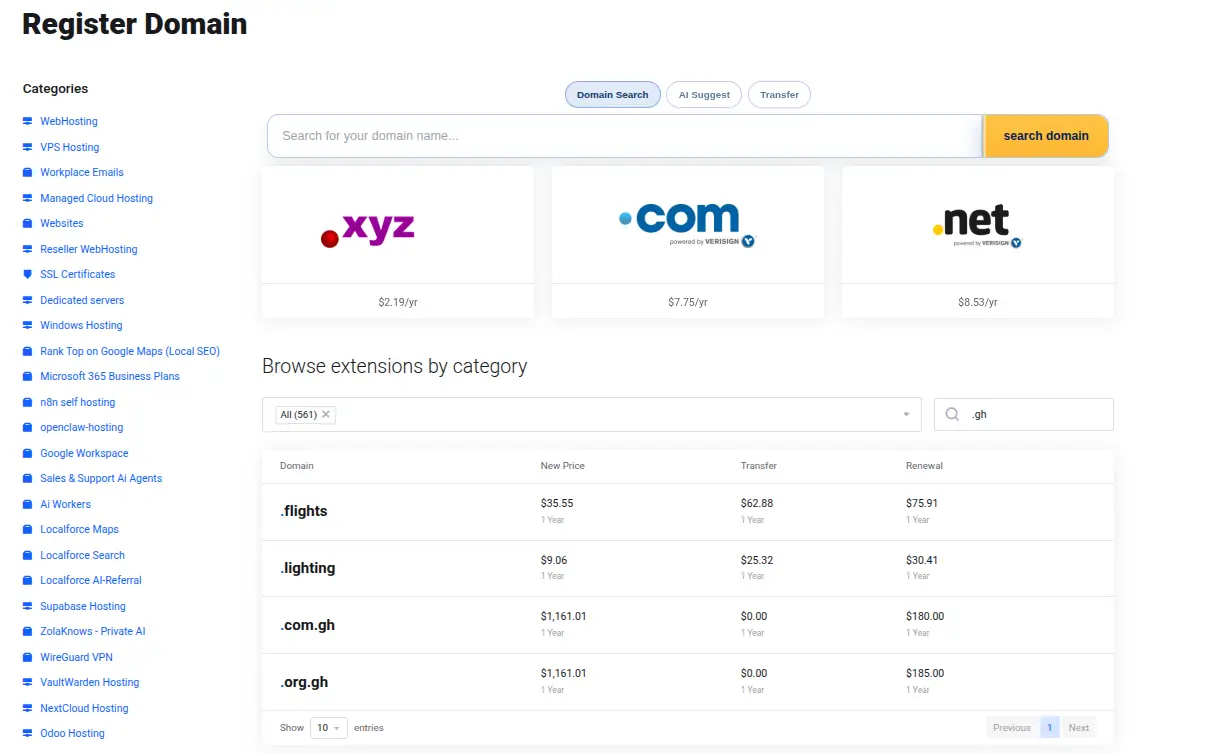
Truehost Ghana stands out for buyers who specifically want a .com.gh domain alongside conventional extensions such as .com and .net.
Its Ghana platform lists .com.gh at $150, while its current domain catalogue lists .com at $7.75 and .net at $8.53. It also currently advertises a promotional .top registration price of $0.99.
The biggest distinction isn’t simply the price of a .com domain.
Truehost offers access to Ghana-specific extensions while also providing the more familiar global TLDs.
That gives a business the flexibility to use .com for a broader audience and .com.gh when establishing a stronger Ghanaian identity.
For Ghanaian customers, the local platform is another consideration.
Truehost combines domain registration with hosting, email, SSL and other website services, meaning customers can keep several parts of their online setup within the same account.
Its Ghana-focused service also supports local payment methods, which can make the purchasing process more convenient than dealing exclusively with an international registrar.
The pricing difference between .com and .com.gh is significant, however.
A standard .com is considerably cheaper, while .com.gh carries the higher cost associated with the local namespace.
Businesses therefore need to decide whether the stronger Ghana-specific identity is worth the additional annual expense.
Truehost is particularly relevant for businesses whose customers are predominantly in Ghana and who want .gh domain registration and hosting services from one provider.
b) GoDaddy
GoDaddy is one of the largest international domain registrars and offers hundreds of domain extensions alongside hosting, website-building and business tools.
Its current public pricing shows a promotional .com price of $0.01 for the first year, although the offer requires a three-year purchase and additional years are charged at the regular rate.
Its .top page currently lists $4.29 for the first year.
The registrar also supports .net and a large catalogue of other generic and country-specific extensions.
GoDaddy’s domain platform is designed for customers who want more than simply a domain name, with website builders, hosting, email, security and other business services available from the same account.
For a Ghanaian customer, though, GoDaddy is a different proposition from a local registrar. Its major advantage is the sheer breadth of its international domain catalogue and its mature domain-management platform.
If you’re building a brand that may eventually operate across multiple countries, that broad selection can be useful.
The introductory pricing also needs to be read carefully.
A $0.01 first-year .com looks dramatically cheaper than the standard price, but the promotion comes with purchase conditions.
The same principle applies to other discounted TLDs: the price at registration isn’t necessarily the price you’ll pay when the domain renews.
GoDaddy therefore makes the most sense for users who value a large international registrar, extensive TLD selection and a broad range of additional online-business tools, rather than specifically needing Ghanaian local-domain services.
c) Namecheap
Namecheap takes a more straightforward registrar-focused approach and is particularly known for competitive domain pricing and included privacy protection on eligible domains.
Its current public pricing lists .com at $10.98, .net at $11.98 and .top at $2.98 for first-year registration under the current sale pricing.
The registrar also makes the renewal cost visible, which is useful because the introductory price is not necessarily what you’ll pay in subsequent years.
For example, its current listed renewal prices are $18.48 for .com, $18.58 for .net and $6.98 for .top.
Another notable feature is free lifetime domain privacy on eligible domains.
Namecheap says its privacy service masks personal contact information from public WHOIS records, so customers don’t have to purchase a separate privacy subscription for eligible extensions.
For someone in Ghana, the major limitation is the local extension.
Namecheap’s publicly available domain catalogue provides strong support for generic extensions such as .com, .net and .top, but it isn’t a natural choice if your priority is registering a .com.gh domain.
That makes Namecheap more suitable for businesses, creators and developers who want a conventional global domain at a competitive price.
If your website is intended to serve Ghana as part of a wider international market, a .com from Namecheap can make sense.
If demonstrating a formal Ghanaian digital identity is the priority, however, a registrar that directly supports .gh extensions is more relevant.
d) HostAfrica Ghana
HostAfrica Ghana takes a more locally oriented approach, combining domain registration with web hosting and other infrastructure services.
Its current Ghana pricing comparison lists .com at GH₵260 and .net at GH₵145, while a public .com.gh price is not currently displayed.
The company is particularly relevant to businesses that want a domain and hosting provider with an established African presence. Rather than focusing exclusively on domain registration, HostAfrica offers hosting and other website infrastructure, allowing customers to keep their domain and hosting accounts together.
Its large domain catalogue is another selling point.
HostAfrica supports hundreds of domain extensions, giving businesses more flexibility when their preferred .com name isn’t available.
That can be useful when choosing between a traditional extension such as .com or .net and a newer, more descriptive TLD.
For Ghanaian businesses, the local-facing support is also worth considering.
A registrar can have attractive headline pricing but still become frustrating if customers have difficulty getting help with DNS, domain transfers or hosting configuration.
Having domain and hosting services with one provider can simplify those tasks.
HostAfrica is therefore a solid option for buyers who want domain registration combined with hosting and African-focused support, particularly if they don’t specifically require a .com.gh domain.
e) Squarespace Domains
Squarespace Domains is a little different from the other registrars because domain registration sits alongside the company’s website-building platform.
Google Domains is no longer a standalone option; Squarespace acquired the Google Domains assets in 2023 and completed the migration of Google Domains customers in 2024.
For new registrations, customers deal directly with Squarespace rather than Google.
Squarespace’s current domain pricing guide gives a general range of $10–$20 per year for .com and $12–$20 for .net, depending on the extension and other pricing factors.
One advantage of Squarespace is the simplicity of managing a domain alongside a website. Its domain service includes privacy protection for eligible domains, and Squarespace emphasizes transparent checkout pricing.
This can appeal to someone who wants to build a website and register its domain without juggling several separate platforms.
Squarespace also integrates professional email through Google Workspace, which can be useful for businesses that want their website, domain and email setup connected.
However, it isn’t particularly Ghana-specific.
Someone whose primary requirement is a .com.gh domain would have better reason to look at a registrar that actively supports Ghana’s local namespace.
Squarespace is more naturally suited to users who prioritize website building, simple domain management and an international-facing .com or .net address.
Common Mistakes to Avoid
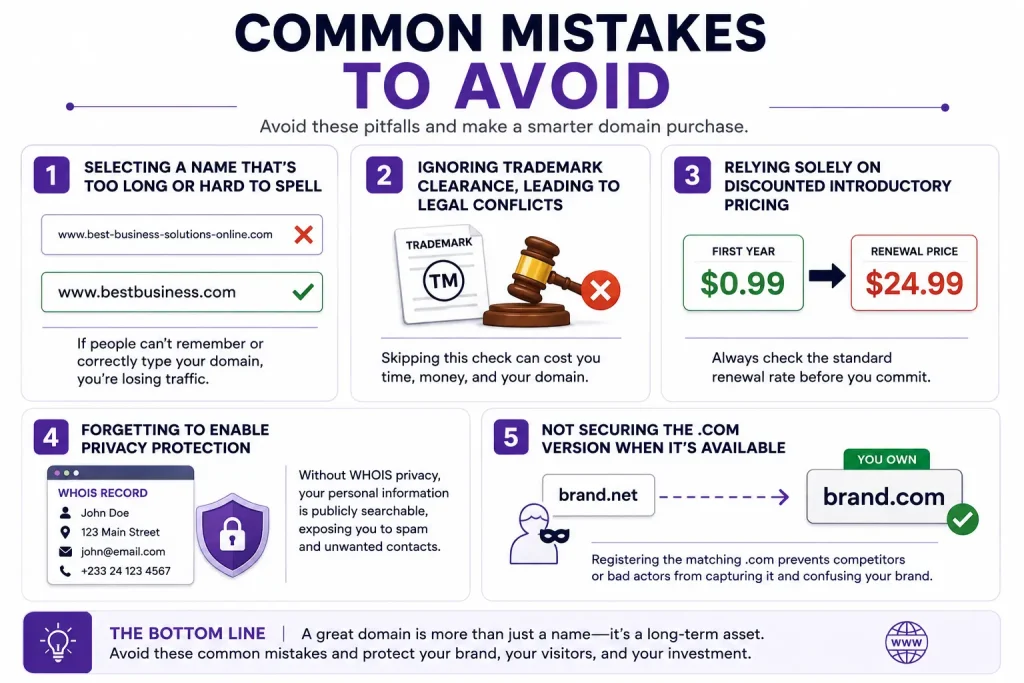
Even careful buyers fall into a few recurring traps when purchasing a domain.
- Selecting a name that’s too long or hard to spell. If people can’t remember or correctly type your domain after hearing it once, you’re losing traffic before they even reach your site.
- Ignoring trademark clearance, leading to legal conflicts. Skipping this check to save a few minutes can cost you far more time and money later if a trademark holder files a UDRP complaint or pursues legal action against your registration.
- Relying solely on discounted introductory pricing. A domain advertised at a rock-bottom first-year price often renews at two or three times that amount. Always check the standard renewal rate before you commit, so you’re not caught off guard a year later.
- Forgetting to enable privacy protection. Without WHOIS privacy, your personal contact information, name, address, email, and phone number, becomes publicly searchable, which can expose you to spam, unwanted solicitations, or worse.
- Not securing the .com version when it’s available. Even if you plan to primarily use a different extension, registering the matching .com defensively prevents competitors or bad actors from capturing it and creating brand confusion down the line.
Buy a Domain Today!
Buying a domain is a small purchase with outsized consequences for your brand’s credibility, discoverability, and long-term flexibility.
Taking the time to check trademarks, understand dispute policies, secure protective variations, and keep your ownership details accurate isn’t just administrative housekeeping, it’s a genuine safeguard for everything you’ll build on top of that domain in the years ahead.
Now that you know what to look for and what to avoid, there’s no reason to keep putting it off.
Head over to Truehost Ghana, search for your ideal name, and follow the steps outlined here to buy your domain today with confidence, local support, and pricing that won’t surprise you at renewal.