 Domains SearchSearch available domain names and claim yours in just a few clicks.
 .GH DomainsFind and register a trusted .gh domain for your business or idea.
 Web HostingAffordable web hosting solutions designed for performance, uptime, and scalability.
 cPanel HostingManage your website without the stress. cPanel hosting gives you everything in one place.
 Reseller HostingCreate, manage, and grow your hosting clients using reliable reseller hosting tools.
 Windows HostingWindows hosting that works smoothly with Microsoft frameworks and applications.
 Email HostingProfessional email hosting that keeps your business communication reliable and secure.
 WordPress HostingFast and secure WordPress hosting optimized for smooth performance and easy management.
 Affiliate ProgramEarn commissions by referring customers to our hosting and domain services.
 .COM Domains
 All DomainsFind the right Ghana domain for your brand and lock it in fast.
 Domain TransferMove your domain to us with a smooth, secure transfer process.
 Whois LookupCheck domain ownership and registration details instantly with our WHOIS lookup.
 SSL CertificatesSecure your website and protect your visitors with trusted SSL certificates.
 VPS HostingUpgrade to VPS hosting today and enjoy better speed, uptime, and flexibility.
 Managed VPSManaged VPS for businesses and developers who want full control without server management worries.
 Dedicated ServersGet maximum speed and reliability with dedicated servers built for serious websites and apps.
 AI Website BuilderStart your website today with our AI builder and go live in minutes.
 Online ShopStart selling online today with your own professional online shop.
 Web Design ServiceProfessional web design services that make your brand stand out online.
 Local SEO
 BlogHelpful articles, tutorials, and updates for building your online presence.
 Contact UsNeed help or more information? Connect with us anytime.
If you’ve ever typed a website address into your browser, chances are it ended in .com.
It’s the extension that comes to mind first for most internet users, and it remains the default choice for businesses, bloggers, and brands around the world.
But what exactly makes .com so dominant, and is it still the best choice in 2026? Let’s break it down.
Definition and Basic Concept
A .com domain is simply a website address that ends with the three letters com, short for commercial.
It’s classified as a generic top-level domain, or gTLD, meaning it isn’t tied to any specific country or region the way .gh or .co.uk are.
When you register a .com domain, you’re essentially renting the rights to that address for a set period, usually a year at a time, from an accredited registrar.
You don’t own it outright in a permanent sense; you renew it to keep control of it, similar to leasing a plot of land rather than buying it outright.
Technically, a .com domain works as a human-readable stand-in for a numerical IP address.
Instead of typing a long string of numbers to reach a server, you type a memorable name, and the Domain Name System translates that into the correct address behind the scenes.
This simple bit of infrastructure is what makes the entire web navigable for ordinary users.
Historical Background and Evolution
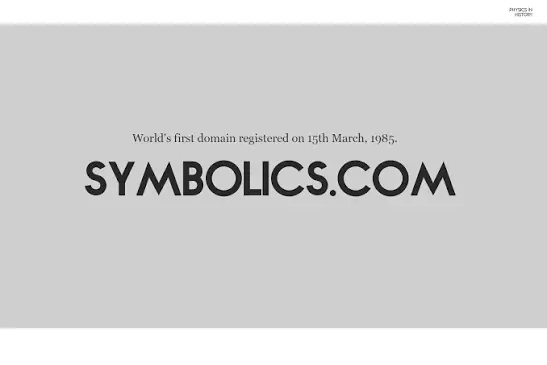
The .com extension dates back to March 1985, when Symbolics.com became the very first domain ever registered.
At the time, the internet was still a research and academic network, and nobody could have predicted that this quiet administrative registration would eventually anchor the commercial internet.
Throughout the late 1980s and early 1990s, .com registrations remained slow, largely limited to tech companies and early adopters experimenting with this new digital space.
Everything changed in the mid-to-late 1990s during the dot-com boom.
As businesses rushed online and investors poured money into internet startups, .com became the extension of choice almost by default.
Companies scrambled to register short, memorable .com names, and by the early 2000s, the extension had become so closely tied to legitimacy that a business without a .com address often seemed incomplete or untrustworthy in the eyes of consumers.
Even after the dot-com bubble burst, that association stuck.
Decades later, despite the arrival of dozens of new extensions like .io, .co, and .biz, .com has held onto its position as the internet’s default namespace, and it shows no real sign of losing that status anytime soon.
What Makes .com Domains Unique
Well it’s a variety of reasons really:
1) Global Recognition and Brand Perception
There’s a reason so many companies fight hard to secure the .com version of their name, even when a cheaper alternative extension is readily available.
Global recognition is very important.
A .com domain signals to visitors from any country that your business is accessible, established, and playing by familiar rules.
Unlike country-code extensions that carry regional connotations, .com reads as universal, making it a natural fit for businesses that want to appear credible to an international audience.
2) Trust Factor for Online Users
People have learned, sometimes the hard way, to be cautious online.
A .com domain doesn’t guarantee legitimacy, but it does lower the psychological barrier for a first-time visitor.
When someone lands on an unfamiliar website, an unusual or obscure extension can trigger a small moment of hesitation, while .com rarely does.
That subtle difference in comfort level can influence whether someone completes a purchase, signs up for a newsletter, or simply closes the tab.
3) Strong brand credibility
Businesses that secure the .com version of their name are often perceived as more established, even if the company is brand new.
It signals that you’ve invested in your identity rather than settling for a workaround.
4) High memorability for customers
Because .com is so deeply ingrained in how people think about web addresses, customers are far more likely to correctly recall and retype a .com address from memory than an unfamiliar extension.
5) Preferred status in search engine rankings
While search engines don’t officially rank .com domains higher purely because of the extension, the trust signals and established backlink patterns associated with .com sites often correlate with stronger overall SEO performance over time.
Pricing Structures and Renewal Policies
Domain pricing varies more than most first-time buyers expect, and the gap between registration and renewal cost is often where people get caught off guard.
Here’s how five popular registrars compare on .com pricing.
a) Truehost
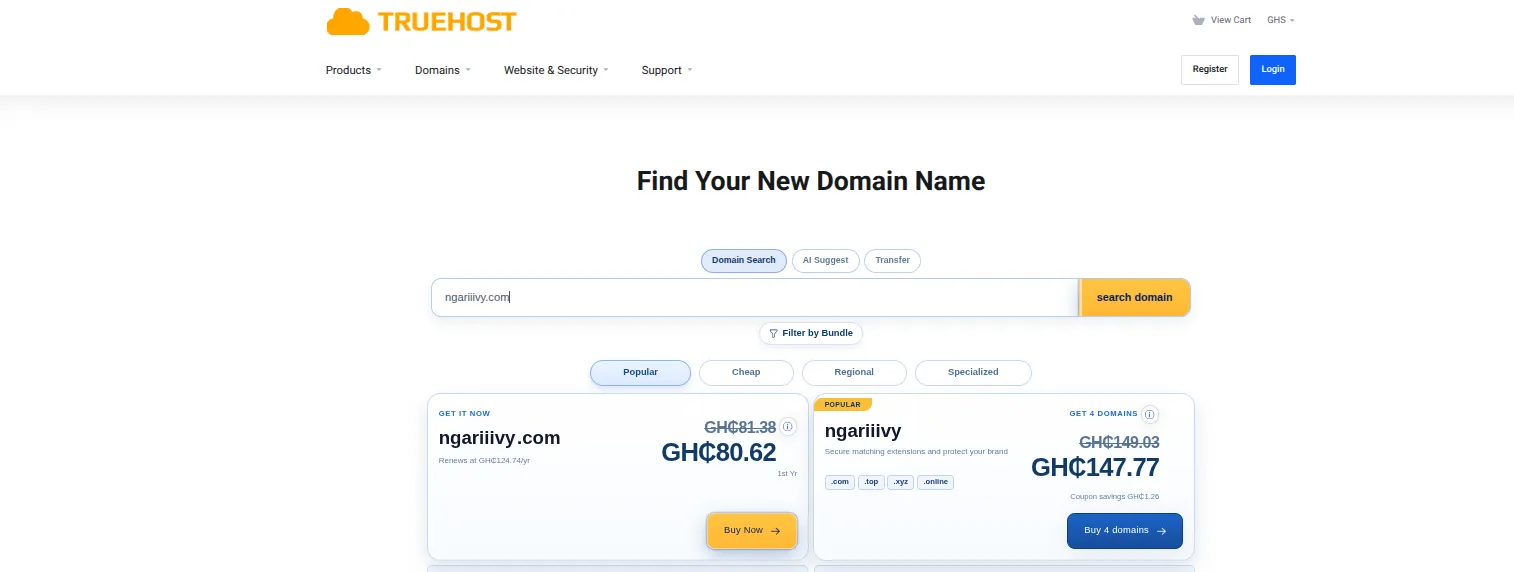
Truehost keeps its .com pricing competitive and accessible, with registration typically landing around GH₵86.63 for the first year and a renewal price of GH₵124.74.
Truehost Ghana bills in cedis directly through local payment options like Mobile Money, which removes the currency conversion guesswork entirely.
b) Qservers
Qservers focuses primarily on the Nigerian market and is best known for its low-cost shared hosting plans, with domain pricing generally bundled into hosting packages rather than sold heavily as a standalone product.
For bloggers already using Qservers for hosting, registering the domain through the same account tends to be the more convenient route.
c) G Online Sites
As a Ghana-based provider with a broad service catalog, G Online Sites offers domain registration alongside hosting, web design, and other digital services.
Pricing tends to stay competitive with other African registrars, and the appeal here is convenience, since domains, hosting, and support all live under one local account.
d) HostAfrica
HostAfrica’s .com pricing sits a bit higher than budget-focused registrars, with registration starting around $13.80 to $15.08 and renewal climbing to roughly $21.24.
HostAfrica Ghana also bundles in extras like a free .africa domain with certain hosting plans, which can offset the higher standalone domain price if you’re bundling services anyway.
e) Namecheap
Namecheap remains one of the most recognized global registrars, with first-year .com pricing frequently discounted to around $6.79 to $9.58 through promotional codes, before jumping to a standard renewal rate of roughly $13.98 to $14.98.
Namecheap also throws in free WHOIS privacy protection on most TLDs, which some competitors charge extra for.
Renewal Cost Considerations
The pattern across nearly every registrar is the same: the first-year price is almost always discounted to attract new customers, and the renewal price tells the real story.
Namecheap’s .com renewal, for example, runs close to 45% higher than its typical first-year promotional rate.
This isn’t unique to any one company; it’s simply how the domain industry operates.
Before registering anywhere, it’s worth checking the renewal rate specifically, not just the flashy first-year number on the homepage.
Locking in a multi-year registration can also help you sidestep annual price creep, since you pay the agreed rate upfront for the length of the term rather than facing a new price each year.
Alternatives and Complementary TLDs
While .com remains the most recognized extension, it isn’t always the right fit, and it isn’t the only credible option available.
Overview of .org, .net, and Country-Code TLDs
The .org extension was originally intended for non-profit organizations, and that association still lingers today.
Visitors often subconsciously read .org as a signal of a mission-driven or community-focused entity, which makes it a natural choice for charities, advocacy groups, and educational initiatives.
The .net extension was originally meant for network infrastructure and internet service providers, though today it’s used more broadly as a general-purpose alternative when a preferred .com name is already taken.
It carries a slightly more technical connotation but remains widely recognized and trusted.
Country-code TLDs, such as .gh for Ghana, .ng for Nigeria, or .co.uk for the United Kingdom, serve a very different purpose.
Rather than aiming for global reach, these extensions signal a strong local presence.
A .com.gh domain, for instance, tells Ghanaian visitors immediately that a business operates locally, which can build trust with a region-specific audience even if it doesn’t carry the same international recognition as .com.
When to Consider Alternative Extensions
If your ideal .com name is already taken, don’t assume you need to compromise on quality just to force a workaround.
A well-chosen .net or .org can still perform well, provided it fits your brand’s purpose.
For businesses targeting a specific country or local customer base, a relevant ccTLD is often the smarter choice over a generic .com, since it builds immediate local credibility.
And for tech startups or creative projects, newer extensions like .io or .co have carved out their own niche appeal, particularly in industries where a modern, slightly unconventional identity works in your favor rather than against you.
Is .Com Worth It?
Absolutely! Despite the growing number of domain extensions available today, .com remains the gold standard for a reason.
Its decades-long history, near-universal recognition, and the instinctive trust it earns from visitors give it a durability that newer extensions simply haven’t matched yet.
Whether you’re launching a personal blog, a growing business, or an online store, securing a .com domain is still one of the safest, most credible choices you can make for your brand’s online identity.
If you’re ready to claim your .com domain, Truehost Ghana makes the process simple with local cedi pricing, Mobile Money payment options, and no hidden currency surprises at checkout.
Take the first step toward building your online presence and secure your ideal .com domain with Truehost Ghana today.