 Domains SearchSearch available domain names and claim yours in just a few clicks.
 .GH DomainsFind and register a trusted .gh domain for your business or idea.
 Web HostingAffordable web hosting solutions designed for performance, uptime, and scalability.
 cPanel HostingManage your website without the stress. cPanel hosting gives you everything in one place.
 Reseller HostingCreate, manage, and grow your hosting clients using reliable reseller hosting tools.
 Windows HostingWindows hosting that works smoothly with Microsoft frameworks and applications.
 Email HostingProfessional email hosting that keeps your business communication reliable and secure.
 WordPress HostingFast and secure WordPress hosting optimized for smooth performance and easy management.
 Affiliate ProgramEarn commissions by referring customers to our hosting and domain services.
 .COM Domains
 All DomainsFind the right Ghana domain for your brand and lock it in fast.
 Domain TransferMove your domain to us with a smooth, secure transfer process.
 Whois LookupCheck domain ownership and registration details instantly with our WHOIS lookup.
 SSL CertificatesSecure your website and protect your visitors with trusted SSL certificates.
 VPS HostingUpgrade to VPS hosting today and enjoy better speed, uptime, and flexibility.
 Managed VPSManaged VPS for businesses and developers who want full control without server management worries.
 Dedicated ServersGet maximum speed and reliability with dedicated servers built for serious websites and apps.
 AI Website BuilderStart your website today with our AI builder and go live in minutes.
 Online ShopStart selling online today with your own professional online shop.
 Web Design ServiceProfessional web design services that make your brand stand out online.
 Local SEO
 BlogHelpful articles, tutorials, and updates for building your online presence.
 Contact UsNeed help or more information? Connect with us anytime.
A domain name is the address people type into a browser to reach your website, something like truehost.com or example.gh.
It’s your site’s home on the internet, and the piece most visitors will actually remember about you.
But not all domains are structured or used the same way.
Domains can be classified by their hierarchy, their purpose, their geographic association, and their extension.
This guide walks through the main categories worth knowing before you register anything: top-level domains, generic top-level domains, country-code top-level domains, sponsored top-level domains, second-level domains, subdomains, and the newer domain extensions that have shown up over the past decade.
Along the way, we’ll cover a question that comes up a lot for readers in Ghana specifically: whether to go with an international extension like .com or a local one like .gh.
What Are the Main Types of Domains?
Here’s a quick overview before we dig into each type individually.
| Domain Type | Example | Main Purpose |
|---|---|---|
| Generic TLD | .com | General/global use |
| Country-code TLD | .gh | Specific country |
| Sponsored TLD | .edu | Specific communities/purposes |
| Second-level domain | example.com | Registered domain name |
| Subdomain | blog.example.com | Section/service of a website |
| New gTLD | .shop | Specific industries/interests |
It helps to know upfront that types of domains can mean a few different things depending on how you’re slicing it.
You can classify domains by hierarchy (where a piece sits in the address), by purpose (what kind of entity typically uses it), or by extension (the specific suffix itself).
All three lenses show up in this guide, so keep that distinction in mind as we go.
a) Top-Level Domains (TLDs)
The TLD is the final part of a domain name, the piece that comes after the last dot. Common examples include .com, .org, .net, .gh, .uk, and .shop.
Every domain has one, and it’s usually the first signal visitors read when deciding whether a site looks trustworthy or relevant to them.
- Generic Top-Level Domains (gTLDs) are the extensions not tied to any particular country.
The most familiar ones are .com, .org, .net, .info, and .biz, all originally created for broad, general use rather than any specific industry or region.
In more recent years, a wave of newer, more descriptive extensions has joined them, things like .shop, .online, .site, .tech, and .store.
These newer options can describe your business more directly right in the domain, but it’s worth being clear about one thing: a particular extension doesn’t automatically make a website rank higher in search results.
Google can index and rank content from virtually any TLD, so the extension itself is a branding choice, not a shortcut to better rankings.
b) Country-Code Top-Level Domains (ccTLDs)
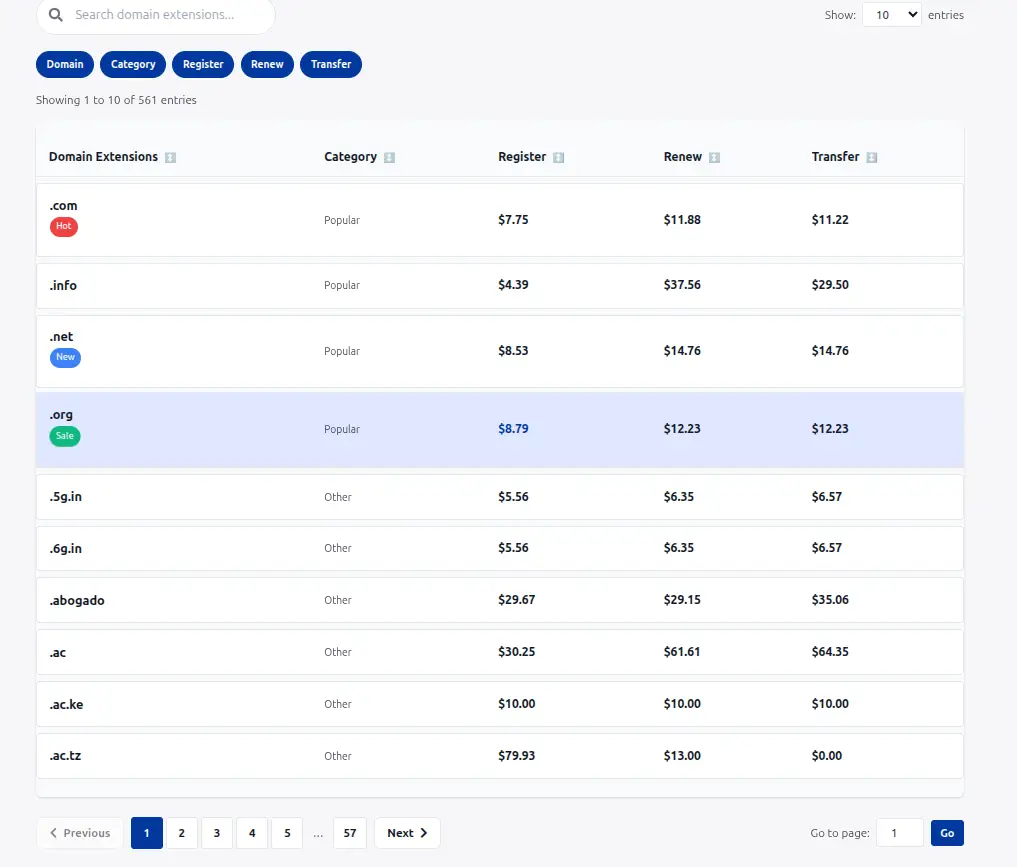
This is where Ghana comes into the picture directly.
Country-code TLDs are generally tied to individual countries or territories, and they’re recognisable at a glance.
Some familiar examples include .gh for Ghana, .ke for Kenya, .ng for Nigeria, .za for South Africa, .uk for the United Kingdom, and .us for the United States.
The .gh domain is the official country-code extension for Ghana.
Local businesses, schools, government bodies, and organisations with a genuine connection to Ghana are the main audience for it.
Ghanaian businesses often choose .gh, or one of its associated sub-extensions, because it signals a clear national identity right in the web address.
For a business specifically targeting Ghanaian customers, that local association can build a bit more immediate trust than a generic extension would on its own.
.gh Domain Levels and Variations work a little differently from a typical .com registration, so here’s how the structure breaks down.
Most .gh registrations happen at the third level, meaning beneath a predefined second-level label, rather than as a direct example.gh registration.
The most common structures include com.gh for commercial businesses and brands, org.gh for organisations and non-profits, edu.gh for accredited educational institutions, and net.gh for network or technology-focused services.
It’s worth being clear that not every one of these is open to just anyone.
Registering a .gh domain generally requires the domain administrator to be based in Ghana, often alongside proof of a Ghana-registered business, and edu.gh specifically requires documentation confirming the applicant is an accredited educational institution.
These eligibility rules do shift over time, so it’s worth confirming the current requirements with your registrar before assuming a particular structure is available to you.
ccTLD vs gTLD, when it comes to choosing between something like .gh and .com, really comes down to a few practical factors.
Geographic identity favours .gh if your audience is primarily Ghanaian, since it immediately signals local relevance.
A global or international audience, on the other hand, is often better served by .com, which carries broader recognition outside any single country.
Branding plays a role too, some businesses register both to protect their name across each option.
Availability can tip the decision as well, a desired .com might already be taken while the equivalent .gh is still open.
And registration requirements differ meaningfully, .com is open to essentially anyone worldwide, while .gh comes with the local eligibility rules described above.
c) Sponsored Top-Level Domains (sTLDs)
Some extensions have traditionally been reserved for particular organisations, communities, or purposes rather than being open to the general public.
Familiar examples include .edu for accredited educational institutions, .gov for government bodies, .mil for military use, and .int for organisations established by international treaty.
These aren’t interchangeable with unrestricted generic extensions, since each one comes with its own eligibility requirements, and registrars typically verify that an applicant genuinely qualifies before completing registration.
d) Second-Level Domains
This is the part most people think of as the domain name itself, the actual name you choose and register.
Take truehost.com as an example: truehost is the second-level domain, and .com is the TLD sitting after it.
The second-level portion is generally where your brand or business name lives, and it’s the piece that carries the most weight in how memorable and recognisable your site becomes.
Branded domains use the business or brand name directly, things like nike.com or example.com.
This is generally the strongest long-term choice for building recognition, since it ties your web presence directly to your actual name.
Keyword-based domains work differently, weaving a descriptive term into the domain itself, something like ghanahostingexample.com.
It’s worth making the SEO point carefully here, since this is one of the more persistent myths in web hosting.
Including a keyword in your domain does not automatically make your website rank higher.
Search engines weigh content quality, technical SEO, and overall authority far more heavily than whatever term happens to sit in your domain name.
e) Subdomains
A subdomain sits before the main domain, separated by a dot, and it’s used to organise a distinct section or service under the same overall brand.
Common examples include blog.example.com, shop.example.com, and support.example.com.
Common uses of subdomains include running a separate blog, a dedicated online store, a customer support portal, a standalone application, a testing or staging environment kept apart from the live site, or a regional version of a website aimed at a specific market.
Subdomain vs subdirectory is a comparison worth knowing, since the two are often confused.
blog.example.com is a subdomain, structurally treated by search engines and servers as somewhat distinct from the main domain. example.com/blog/ is a subdirectory instead, a folder living within the main domain itself.
They’re genuinely different structural approaches with different technical implications, and shouldn’t be treated as interchangeable when deciding how to organise a website.
f) New Domain Extensions
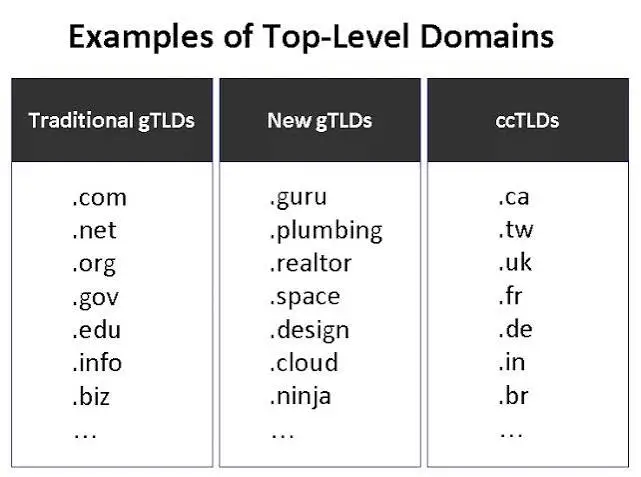
Over the past decade or so, the number of available domain extensions has expanded dramatically.
Newer options now include .online, .website, .store, .shop, .tech, .app, .cloud, and .agency, among many others.
Why new domain extensions exist comes down to a few practical drivers.
They give businesses far more naming options at a time when short, obvious .com names are increasingly hard to find.
They allow for industry-specific branding, a tech startup registering a .tech domain, or a retailer choosing .store, can signal exactly what they do right in the address.
And they open up shorter, more memorable domain possibilities that simply weren’t available under the older, more limited set of extensions.
Are new domain extensions good for SEO? The direct answer is that a newer extension doesn’t automatically provide a ranking advantage just because it happens to describe your business.
Google can index and rank websites using virtually any TLD, generic, country-code, or newer gTLD alike.
The extension itself isn’t the deciding factor, what actually happens on the site is.
Register a Domain With Truehost Ghana
Once you’ve settled on the type of domain that fits your business, actually registering one is the next step, and Truehost Ghana is one option worth considering for that.
A domain search tool lets you check availability across a range of extensions before committing to anything, so you can compare options side by side.
Available extensions typically cover both .gh options, including com.gh, org.gh, and other locally relevant structures, alongside international choices like .com, .net, and .org for businesses wanting broader reach beyond Ghana.
Domain management tools then let you handle renewals, DNS settings, and contact details from one dashboard rather than juggling separate systems.
For anyone setting up a full website, pairing your domain with hosting in one place tends to simplify things considerably, and Truehost offers that combination alongside SSL certificates to get your site running securely from day one.
If you’re ready to register a domain that fits your business and your audience, search for your domain with Truehost Ghana and get your website set up properly from the start.
Frequently Asked Questions About Domain Types
Can I own more than one domain name?
Yes, there’s no limit on how many domain names one person or business can register, whether that’s across different extensions or entirely different names.
Can one website have multiple domain names?
Yes, this is common practice, particularly when businesses register both their .com and local ccTLD versions and redirect one to the other to protect their brand across both.
Can I change my domain extension later?
Not directly, since changing the extension means registering a new domain entirely. You can migrate your website content over and set up redirects from the old domain to the new one, but the underlying registration itself can’t simply be edited.
Can I register a domain without buying hosting?
Yes, domain registration and hosting are separate services, and you can register a domain on its own, then connect it to hosting whenever you’re ready to build your website.
Can I transfer a domain between registrars?
Yes, domains can generally be transferred between accredited registrars, though the exact process, and any local eligibility checks for ccTLDs like .gh, can vary depending on the registry involved.
How long can a domain name be?
Domain names can generally run up to 63 characters for the second-level portion, though shorter names are almost always more practical and easier for visitors to remember and type correctly.
Can I register a domain anonymously?
Some registrars offer privacy protection services that mask your personal contact details in public WHOIS records, though certain ccTLDs, including .gh, may require verified local registrant information regardless of privacy add-ons.
What happens when a domain expires?
An expired domain typically enters a grace period during which the original owner can still renew it, followed by a redemption period with additional fees, before it eventually becomes available for anyone else to register.
Can someone else register my domain after it expires?
Yes, once a domain passes through its grace and redemption periods without being renewed, it becomes available to the public again, and anyone, including competitors, can register it.
Can I use a domain name for email without having a website?
Yes, you can set up professional email addresses on a domain, like [email protected], even without a live website attached to that domain.
Can I buy a domain for several years?
Yes, most registrars allow multi-year registration, and doing so can protect against accidentally letting a domain lapse, though it’s still worth keeping your contact and payment details current to avoid renewal issues.