 Domains SearchSearch available domain names and claim yours in just a few clicks.
 .GH DomainsFind and register a trusted .gh domain for your business or idea.
 Web HostingAffordable web hosting solutions designed for performance, uptime, and scalability.
 cPanel HostingManage your website without the stress. cPanel hosting gives you everything in one place.
 Reseller HostingCreate, manage, and grow your hosting clients using reliable reseller hosting tools.
 Windows HostingWindows hosting that works smoothly with Microsoft frameworks and applications.
 Email HostingProfessional email hosting that keeps your business communication reliable and secure.
 WordPress HostingFast and secure WordPress hosting optimized for smooth performance and easy management.
 Affiliate ProgramEarn commissions by referring customers to our hosting and domain services.
 .COM Domains
 All DomainsFind the right Ghana domain for your brand and lock it in fast.
 Domain TransferMove your domain to us with a smooth, secure transfer process.
 Whois LookupCheck domain ownership and registration details instantly with our WHOIS lookup.
 SSL CertificatesSecure your website and protect your visitors with trusted SSL certificates.
 VPS HostingUpgrade to VPS hosting today and enjoy better speed, uptime, and flexibility.
 Managed VPSManaged VPS for businesses and developers who want full control without server management worries.
 Dedicated ServersGet maximum speed and reliability with dedicated servers built for serious websites and apps.
 AI Website BuilderStart your website today with our AI builder and go live in minutes.
 Online ShopStart selling online today with your own professional online shop.
 Web Design ServiceProfessional web design services that make your brand stand out online.
 Local SEO
 BlogHelpful articles, tutorials, and updates for building your online presence.
 Contact UsNeed help or more information? Connect with us anytime.

Take two companies called Bright Star. One gives customers the address [email protected]. The other uses [email protected].
Both can send and receive email without any trouble. So what’s the real difference?
The difference sits in domain ownership, administration, branding and the features that come with each service.
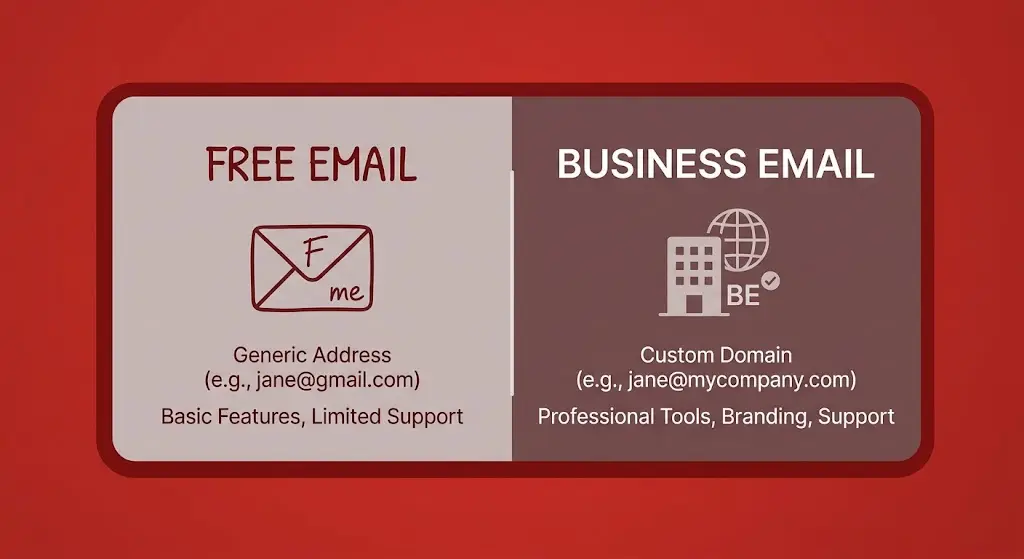
With free email, the provider owns the domain after the @ sign. With business email, you own it.
That one change affects who controls the accounts, how your brand looks and what happens when people join or leave.
This guide walks through free email vs business email, starting with a quick comparison table and then five main differences.
The right choice depends on your size, your budget, your security needs and your plans for growth.
By the end, you’ll know which option fits your company.
Business Email vs Free Email: What’s the Difference?
Here’s the side-by-side view. Read it first, then we’ll go through each point in detail.
| Feature | Free email | Business email |
| Example | [email protected] | [email protected] |
| Domain | Provider’s domain | Business’s custom domain |
| Starting cost | Usually free | Often paid, though some hosting plans include email |
| Branding | Limited control over the address | Uses the business’s domain |
| User management | Personal account settings | May include centralized administration |
| Storage | Depends on the free service | Depends on the hosting plan |
| Security | Varies by provider | Varies by provider and plan |
| Business continuity | Often tied to an individual’s account | Can be managed through business-owned accounts and domain settings |
| Team email addresses | Usually separate personal accounts | Can support role-based addresses and separate employee mailboxes |
One clarification before we go on. Paid business email isn’t automatically more secure than every free account.
Some free services have strong protections. Some paid plans have weak setups.
Security depends on the provider, the configuration and how people use their accounts.
Business Email vs Free Email: 5 Main Differences
1) Professional Branding and Customer Trust
Start with what customers see. An address like [email protected] tells them you use a generic service.
An address like [email protected] tells them the message comes from your company’s own domain.
That consistency helps people recognize your business.
When your website, invoices and email all share one domain, everything lines up. It also keeps employee addresses tied to your brand.
Every person on the team is [email protected]m, and customers can see who they’re dealing with.
A custom address also gives you flexibility. You can create role-based addresses like support@, billing@ and hello@, then point them to the right people.
A word of caution here.
A custom address doesn’t automatically earn trust or boost sales. It’s one signal among many.
Your service, your website and your reputation count for more. But a professional address removes a small point of doubt, and that can help.
For a sole proprietor just testing an idea, a free address can be fine.
As soon as you’re sending quotes, invoices or proposals to new customers, a domain-based address starts to look like the better choice.
2) Cost and Long-Term Expenses
Free email usually has no direct subscription fee. That’s the big draw, especially if you’re starting out with little money.
Business email normally costs something. Some providers charge per mailbox.
Others bundle email into a hosting plan or sell a package with several mailboxes at a flat price. You also need a domain, which has its own registration and renewal cost.
So look at the full picture. Think about domain registration, mailbox limits, renewal prices and the total cost of email for several employees.
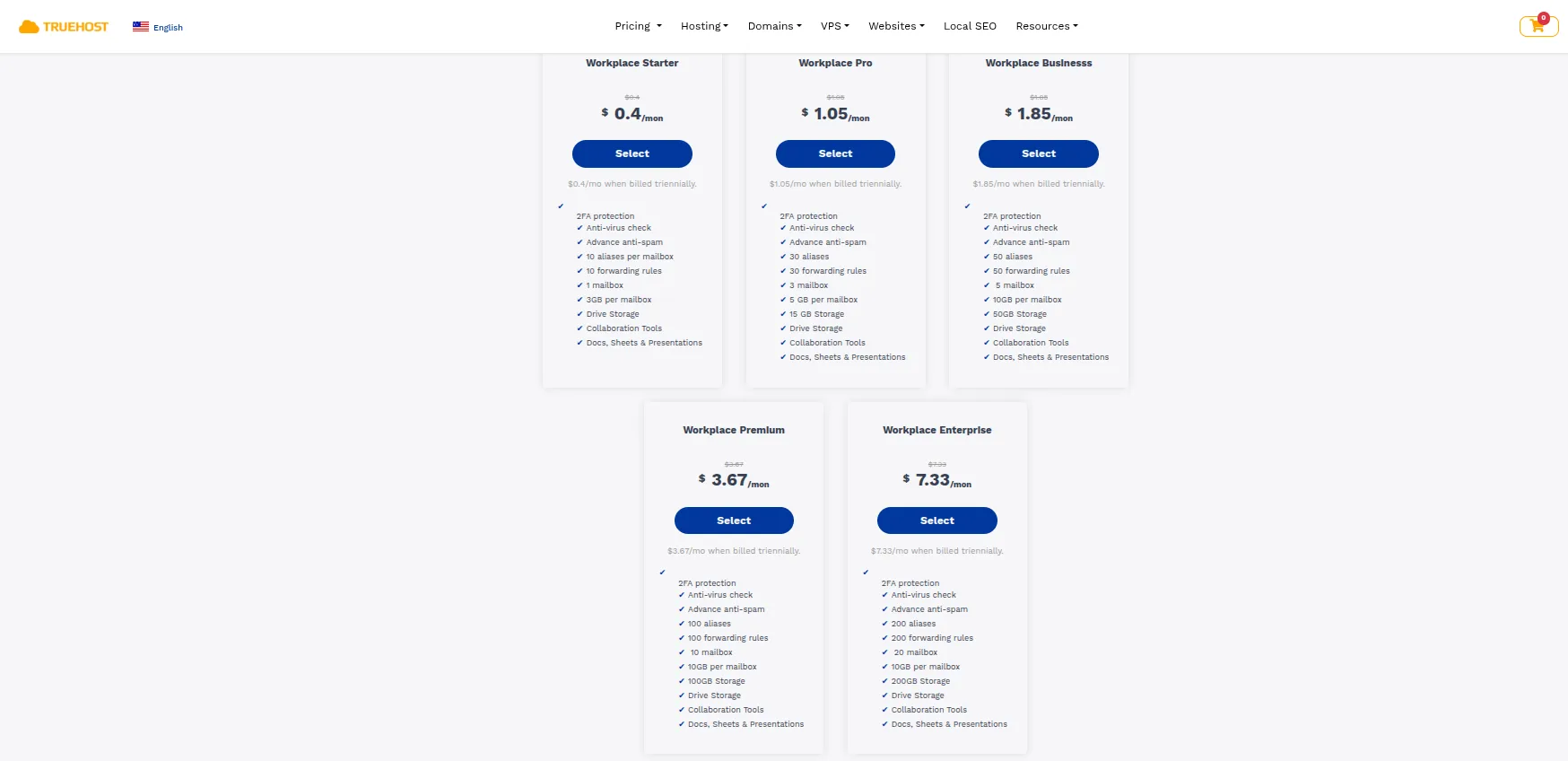
Here’s an example using Truehost’s published prices. Truehost’s global pricing page lists Workplace Starter from $4.80 per year for one mailbox.
Its Workplace Business plan is listed at $22.20 per year and includes five mailboxes, which works out to about $4.44 per mailbox per year.
These are US dollar prices from Truehost’s pricing page, so confirm the current Ghana checkout price and billing term before you budget.
Even so, a small team can get professional email for a modest yearly cost. The real question is whether the extras are worth it to you.
Compare that cost with the value of a branded address, central control and the other benefits below.
3) Security and Account Control
Both free and business email can offer security tools. These include multifactor authentication, spam filtering and account recovery. What you get depends on the provider and the plan.
The bigger difference is control. With free email, each account belongs to an individual.
If an employee leaves, you can’t simply take their account back. Customer conversations, quotes and files may go with them.
With business email, the domain belongs to your company. Accounts are created under it, so you can manage them.
When someone joins, you set up a new mailbox. When someone leaves, you can shut off access, reset the password or forward their mail to a colleague.
That control reduces risk. It also saves time when your team changes.
Security features vary, so check what each plan includes.
For example, Truehost says two-factor authentication, antivirus checks and anti-spam protection come with all five of its Workplace plans.
Other providers may reserve some features for higher tiers. Ask before you buy, and don’t assume.
Whatever you choose, good habits still apply. Use strong, unique passwords and turn on multifactor authentication where it’s offered.
4) Storage and Business Features
Storage and features can differ a lot between the two options. Compare mailbox storage, attachment limits, email apps, calendars, shared tools and support.
Free services give you a set amount of space, and the details depend on the provider. Business plans set storage by the plan you pick.
Some give each mailbox its own storage. Others share a pool across all mailboxes.
Truehost’s Workplace plans, for instance, list separate per-mailbox storage on some tiers and shared storage on others.
Business plans can also add tools that help teams. Shared calendars, document editing, drive storage and administrator controls are common examples.
Truehost’s Workplace plans pair business email with an office suite for documents, spreadsheets and presentations.
Support is another difference. Free services often rely on help pages and forums.
Paid plans may include direct support, which is handy when your email stops working on a busy day.
How much of this you need depends on your size. A sole proprietor answering a few messages a day may need very little.
A company with several employees handling customer enquiries needs more storage, shared tools and a way to manage everyone’s accounts.
5) Ownership and Business Continuity

This difference is easy to overlook until something goes wrong. With a free account, you rely on one person’s login.
If that person forgets the password, loses their phone or leaves the company, getting back in can be hard. The business doesn’t truly own the address.
With a business-owned domain and managed accounts, you stay in control. You can handle access recovery through your admin settings.
You can reassign mail when an employee departs. And the address stays with the company, not the person.
Domain ownership comes with duties, though.
Keep the domain renewed so it never lapses. If a domain expires, your email stops working, and someone else could register it. Set up auto-renewal and a reminder.
Also keep your domain registration details under business control.
Use a company email for the registrant contact, and don’t register the domain in a freelancer’s or an employee’s personal name.
If that person disappears, you could struggle to prove ownership.
These steps take an hour and prevent a lot of pain later.
Choose the Email Option That Fits Your Business
So, which one should you pick? It comes down to what you need right now and where you’re headed.
Free email can be enough for personal use or a small project with basic needs.
If you’re testing an idea, running a hobby or handling a handful of messages, there’s no strong reason to pay.
Business email is worth considering once a company wants custom-domain addresses, central account management and a consistent identity across its team.
If you have employees, take customer enquiries or send proposals, the extra control and brand consistency tend to be worth the cost.
A good rule of thumb is to switch when email becomes part of how you represent the company. At that point, owning your address stops being a nice extra and starts being sensible planning.
Whichever way you go, compare actual plans, not just names.
Check mailbox limits, storage, security features, renewal prices and support. Do the sums for your whole team, and think about where you’ll be in a year or two.
Compare the available Truehost Ghana email hosting plans and check current prices and features to see which option fits your company.