 Domains SearchSearch available domain names and claim yours in just a few clicks.
 .GH DomainsFind and register a trusted .gh domain for your business or idea.
 Web HostingAffordable web hosting solutions designed for performance, uptime, and scalability.
 cPanel HostingManage your website without the stress. cPanel hosting gives you everything in one place.
 Reseller HostingCreate, manage, and grow your hosting clients using reliable reseller hosting tools.
 Windows HostingWindows hosting that works smoothly with Microsoft frameworks and applications.
 Email HostingProfessional email hosting that keeps your business communication reliable and secure.
 WordPress HostingFast and secure WordPress hosting optimized for smooth performance and easy management.
 Affiliate ProgramEarn commissions by referring customers to our hosting and domain services.
 .COM Domains
 All DomainsFind the right Ghana domain for your brand and lock it in fast.
 Domain TransferMove your domain to us with a smooth, secure transfer process.
 Whois LookupCheck domain ownership and registration details instantly with our WHOIS lookup.
 SSL CertificatesSecure your website and protect your visitors with trusted SSL certificates.
 VPS HostingUpgrade to VPS hosting today and enjoy better speed, uptime, and flexibility.
 Managed VPSManaged VPS for businesses and developers who want full control without server management worries.
 Dedicated ServersGet maximum speed and reliability with dedicated servers built for serious websites and apps.
 AI Website BuilderStart your website today with our AI builder and go live in minutes.
 Online ShopStart selling online today with your own professional online shop.
 Web Design ServiceProfessional web design services that make your brand stand out online.
 Local SEO
 BlogHelpful articles, tutorials, and updates for building your online presence.
 Contact UsNeed help or more information? Connect with us anytime.
Most websites start out on shared hosting, and for a while, that works just fine.
But as traffic grows, or as a business starts running more demanding applications, shared hosting starts to show its limits.
Slower load times, unpredictable performance and limited control become harder to ignore.
This is usually where VPS hosting enters the conversation.
In simple terms, VPS hosting divides a physical server into several separate virtual servers, each with its own dedicated resources and isolated environment.
It sits comfortably between shared hosting and a full dedicated server, offering more power and control without the higher price tag of owning an entire machine.
In this article, we will walk through ten advantages of VPS hosting that explain why so many growing businesses and developers eventually make the switch.
10 Advantages of VPS Hosting
The biggest difference between VPS hosting and shared hosting comes down to three things: greater resource allocation, stronger isolation and more control.
Each advantage below builds on one or more of these core strengths.
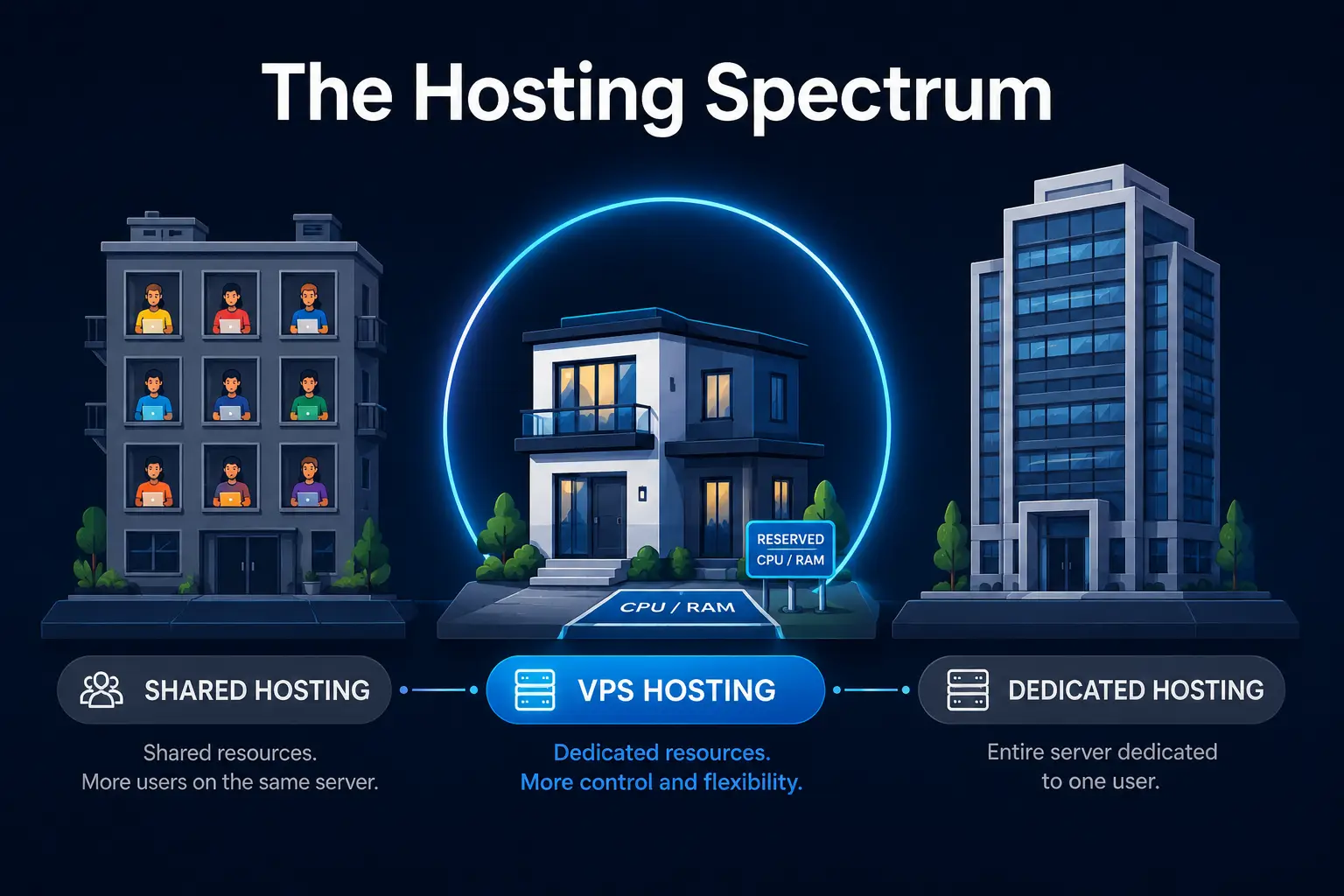
1) More Consistent Website Performance
On shared hosting, your website shares its resources with many other accounts on the same server.
If one of those websites suddenly experiences a traffic spike, everyone else sharing that server can feel the impact, including you.
VPS hosting changes this by allocating a defined share of resources specifically to your account.
This does not mean every VPS is automatically faster than every shared hosting plan, since performance still depends on the specific resources and provider involved.
What it does mean is that your performance becomes far more predictable, since it is no longer tied to what other unrelated accounts happen to be doing at any given moment.
This kind of consistency counts for a lot with business websites, ecommerce stores and applications where slow or unpredictable load times can directly affect sales and user experience.
To put this in practical terms, imagine two identical websites, one on shared hosting and one on a VPS.
During a normal day, both might perform similarly.
But the moment another shared hosting customer on the same server launches a big promotion or gets featured somewhere unexpected, the shared hosting website could slow down noticeably, purely as a side effect of someone else’s success.
The VPS website, with its own reserved resources, would not feel that same ripple effect.
2) Dedicated Resource Allocation
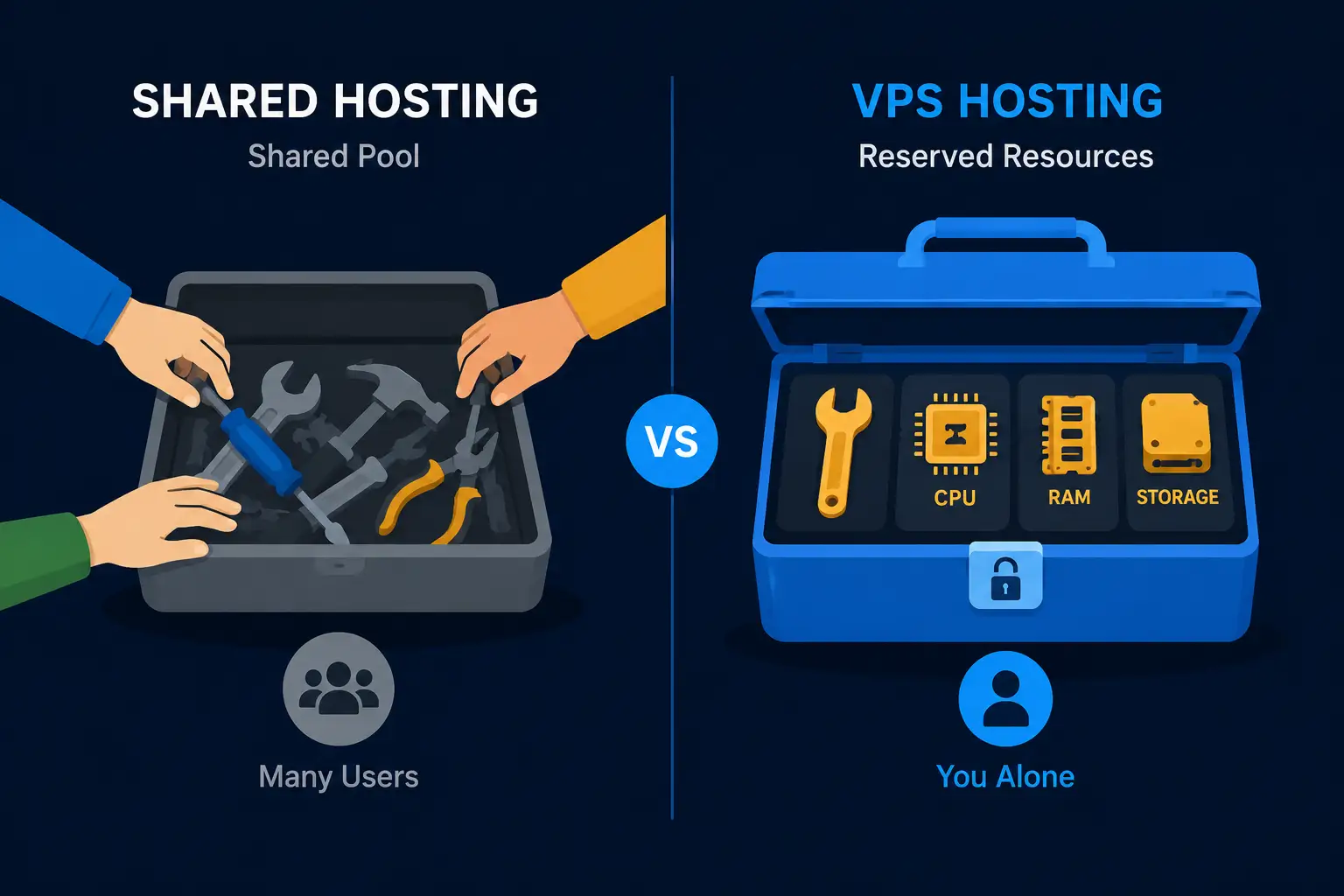
VPS hosting gives you a defined share of CPU, RAM and storage that belongs to your account alone.
Rather than competing with other users for these resources, your VPS reserves them specifically for your use.
This allocation makes a real difference for websites handling heavier workloads, such as larger databases, more complex applications or higher volumes of daily visitors.
As your website or application grows, having dedicated resources available means you are working with a stable foundation rather than a shifting, shared pool that changes based on what everyone else is doing.
Think of it as the difference between owning your own toolbox and borrowing tools from a shared workshop.
When the tools are yours alone, you always know exactly what you have available and can plan your work accordingly.
A shared toolbox might have everything you need one day and nothing the next, depending on who got there first.
Dedicated resource allocation gives your website that same kind of predictability.
3) Easier Scalability
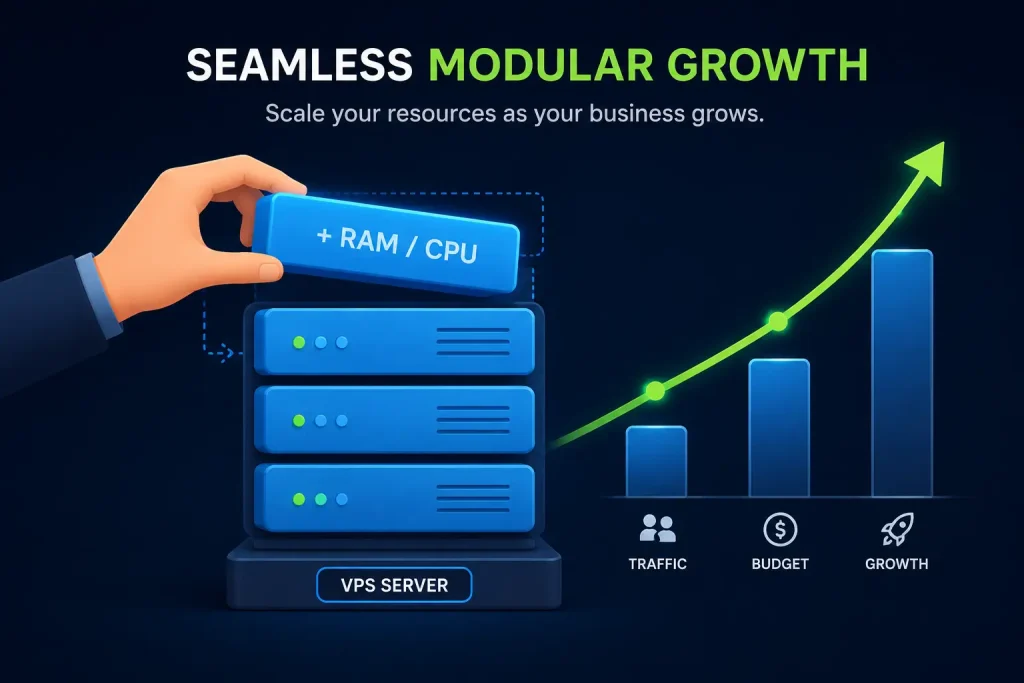
As your website’s needs grow, VPS hosting generally makes it straightforward to increase your resources rather than starting over on a new server.
Most providers allow you to upgrade CPU, RAM and storage as needed, often with minimal downtime involved.
This is valuable because it lets businesses grow gradually, adding resources only when they are actually needed, rather than jumping straight to a dedicated server before it makes financial sense.
Available upgrade options do vary depending on your provider and specific plan, so it is worth checking what a host allows before committing, but scalability remains one of the more practical advantages of VPS hosting for growing businesses.
This gradual approach to growth also helps with budgeting.
Rather than committing to a large upfront cost for a dedicated server you might not fully need for another year or two, you can add resources in smaller increments as your traffic and workload actually justify it.
This keeps your hosting costs aligned with your real usage, rather than paying for capacity that sits unused.
4) Greater Server Control
Compared with shared hosting, VPS hosting typically gives users far more control over their server environment.
This includes control over server configuration, the ability to install custom software, and the flexibility to configure specific services exactly how you need them.
Developers and businesses with particular technical requirements benefit significantly from this flexibility.
Rather than working within the fixed limitations that shared hosting environments usually impose, a VPS lets you shape the server around your application’s actual needs.
This kind of control also opens the door to running less common configurations that shared hosting typically will not support at all.
Custom server modules, specific runtime versions, or unusual combinations of software can all be set up on a VPS in ways that simply are not possible when you are sharing a server with dozens of other unrelated accounts, each with their own competing requirements.
5) Root or Administrator Access
Most VPS hosting plans include root or administrator access, giving you full authority over your server environment.
This lets you install and configure software freely, manage the services running on your server, and customize your hosting environment in ways that shared hosting simply does not allow.
That said, this level of access comes with real responsibility attached.
On unmanaged VPS plans especially, you are the one responsible for keeping your server secure, updated and properly configured.
Root access is a powerful tool, but it works best in the hands of someone prepared to use it carefully.
If you are not confident in managing a server yourself, many providers offer managed VPS hosting, where the provider handles much of this responsibility on your behalf.
This gives you access to a similar level of control without requiring you to personally manage every technical detail involved in keeping the server running smoothly.
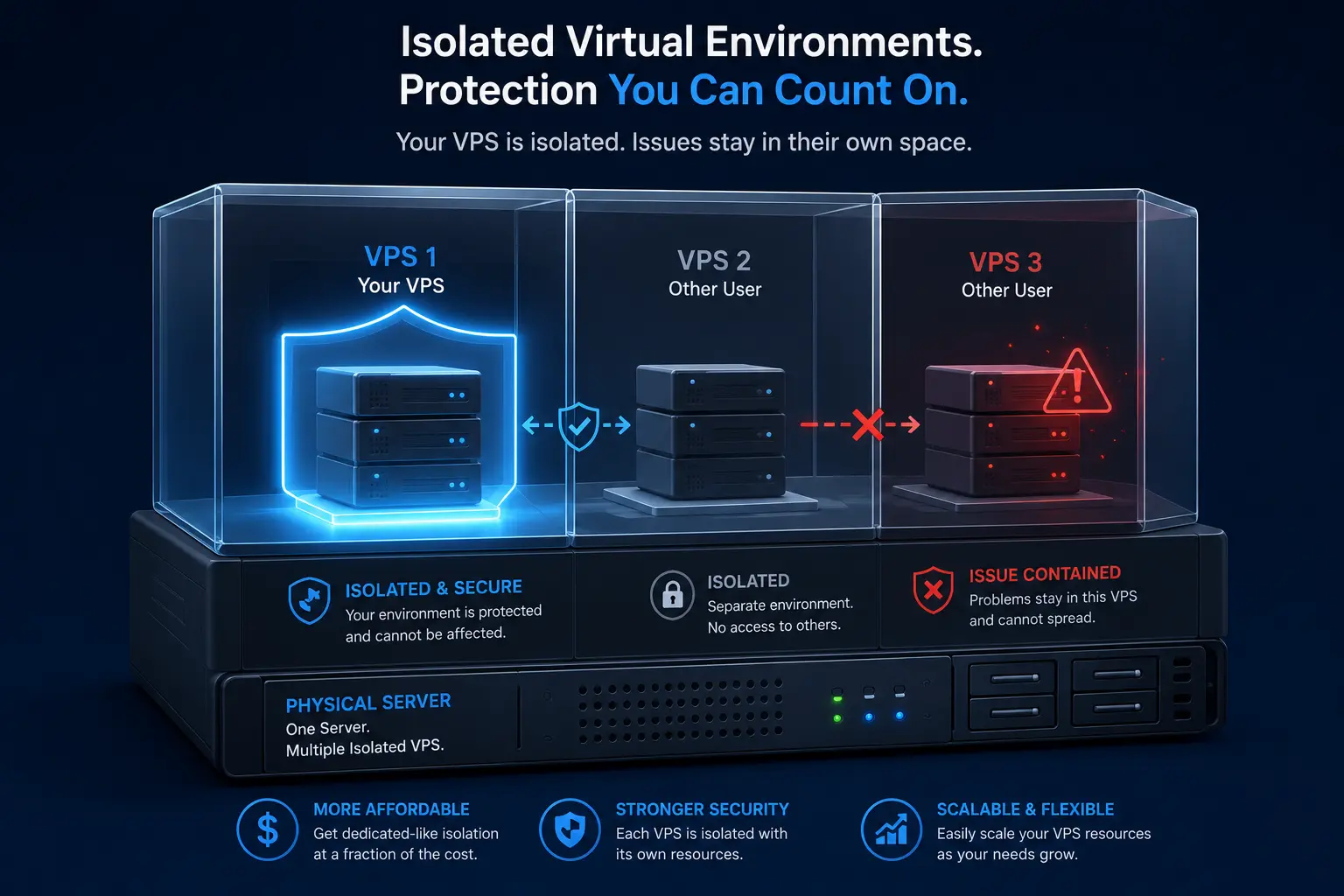
6) Better Isolation From Other Users
Because each VPS operates in its own separate environment, problems occurring on someone else’s VPS generally have far less direct impact on yours compared to shared hosting.
If another account on a shared server experiences a security issue or a sudden resource spike, your site could feel the effects too.
On a VPS, that kind of spillover is much less likely.
This isolation supports both resource stability and a stronger security posture.
It is worth being clear, however, that isolation does not make a VPS completely immune to security problems.
Your own configuration, software updates and general server maintenance still play a major role in keeping your environment safe.
It helps to think of isolation as one layer of protection among several, rather than a complete solution on its own.
A well-isolated VPS that is poorly maintained can still run into serious problems, while a properly maintained VPS benefits from isolation as an added layer of defense on top of good security habits.
7) More Customization and Flexibility
VPS hosting generally allows for a wider range of customization than shared hosting.
Depending on your provider, this can include different operating systems, custom software stacks, specific database configurations, and your choice of web server or development tools.
This flexibility is particularly valuable for developers, agencies and businesses running specialized applications that need a specific technical setup to function properly.
Rather than adapting your project to fit a rigid shared hosting environment, a VPS lets you build the environment around your project instead.
8) Greater Control Over Security
The added control and isolation that come with VPS hosting also translate into real security advantages.
You can configure your own firewalls and access controls, manage software and security updates on your own schedule, and control exactly which services run on your server.
It is important to be honest about what this does and does not mean.
VPS hosting does not automatically make a website secure.
Real security still depends heavily on how well the server is configured and maintained over time.
What VPS hosting offers is the tools and access needed to build strong security, not a guarantee that comes built in by default.
A VPS with outdated software, weak passwords or an unpatched operating system remains vulnerable regardless of how much control or isolation it provides.
The advantage here lies in having the tools available to build a genuinely secure setup, provided someone actually takes the time to use them properly.
9) Suitable for More Demanding Websites and Applications
Because of the resources and control VPS hosting provides, it tends to suit a wide range of demanding workloads far better than shared hosting can.
This includes ecommerce stores handling regular transactions, high-traffic websites drawing large volumes of visitors, and business applications supporting daily operations.
VPS hosting also works well for SaaS platforms, APIs, database-heavy applications, and development environments where testing and experimentation happen regularly.
Websites running multiple services at once, such as a main site alongside a separate application or staging environment, also benefit from the added resources and flexibility a VPS provides, making these kinds of workloads considerably easier to manage day to day.
Agencies managing several client websites often find VPS hosting particularly useful too, since it allows them to host multiple projects on a single server while keeping each one reasonably isolated from the others.
This setup can simplify billing, server management and overall oversight compared to juggling separate hosting accounts for every client.
10) More Affordable Than a Dedicated Server
VPS hosting occupies a useful middle ground between shared hosting and a full dedicated server.
It gives users considerably more resources and control than shared hosting, without requiring them to pay for an entire physical machine on their own.
This makes VPS hosting attractive to growing businesses and developers who have outgrown shared hosting but do not yet need, or cannot yet justify, the cost of a dedicated server.
It is worth noting that VPS pricing is not universally cheaper across the board, since costs vary quite a bit depending on the provider, the resources included and the specific configuration you choose.
Even so, for many growing projects, a VPS delivers a meaningfully better balance of cost and capability than the alternatives on either side of it.
For a small business weighing its options, this middle ground often ends up being the practical choice.
A dedicated server may offer more raw power than the business actually needs at its current size, while shared hosting may already be holding growth back.
VPS hosting fills that gap, offering enough headroom to grow into without the upfront cost of a full physical server sitting mostly unused.
Choose the Right VPS Hosting Plan
Taken together, these advantages of VPS hosting come down to a few core strengths: more consistent performance, dedicated resource allocation, easier scalability, greater control, stronger isolation and far more flexibility than shared hosting can offer.
That said, VPS hosting is not automatically the right choice for everyone.
If your website is small, low-traffic and unlikely to grow significantly in the near future, shared hosting may still serve you perfectly well.
The best fit for VPS hosting is generally someone who has already outgrown shared hosting, or who needs more control over their hosting environment than a shared plan allows.
Weighing these factors honestly, rather than following general hype about VPS being the obvious upgrade for everyone, leads to a much better hosting decision in the long run.
If you are a business or website owner in Ghana looking for more resources and control over your hosting setup, Truehost Ghana’s VPS plans are worth comparing against what you currently have.
Taking a look at the available configurations can help you figure out whether now is the right time to make the move.