 Domains SearchSearch available domain names and claim yours in just a few clicks.
 .GH DomainsFind and register a trusted .gh domain for your business or idea.
 Web HostingAffordable web hosting solutions designed for performance, uptime, and scalability.
 cPanel HostingManage your website without the stress. cPanel hosting gives you everything in one place.
 Reseller HostingCreate, manage, and grow your hosting clients using reliable reseller hosting tools.
 Windows HostingWindows hosting that works smoothly with Microsoft frameworks and applications.
 Email HostingProfessional email hosting that keeps your business communication reliable and secure.
 WordPress HostingFast and secure WordPress hosting optimized for smooth performance and easy management.
 Affiliate ProgramEarn commissions by referring customers to our hosting and domain services.
 .COM Domains
 All DomainsFind the right Ghana domain for your brand and lock it in fast.
 Domain TransferMove your domain to us with a smooth, secure transfer process.
 Whois LookupCheck domain ownership and registration details instantly with our WHOIS lookup.
 SSL CertificatesSecure your website and protect your visitors with trusted SSL certificates.
 VPS HostingUpgrade to VPS hosting today and enjoy better speed, uptime, and flexibility.
 Managed VPSManaged VPS for businesses and developers who want full control without server management worries.
 Dedicated ServersGet maximum speed and reliability with dedicated servers built for serious websites and apps.
 AI Website BuilderStart your website today with our AI builder and go live in minutes.
 Online ShopStart selling online today with your own professional online shop.
 Web Design ServiceProfessional web design services that make your brand stand out online.
 Local SEO
 BlogHelpful articles, tutorials, and updates for building your online presence.
 Contact UsNeed help or more information? Connect with us anytime.
If you have been searching for a way to grow your website beyond the limits of shared hosting, you have probably come across the term VPS hosting.
So what is VPS hosting, and why do so many businesses and developers in Ghana keep recommending it?
In simple terms, VPS hosting stands for Virtual Private Server hosting.
It is a type of web hosting where a single physical server is divided into several separate virtual servers, each acting as its own independent unit.
Each VPS gets its own allocated resources, including CPU, RAM and storage, along with an isolated environment that functions independently of every other VPS on the same physical machine.
This is what makes VPS hosting fundamentally different from shared hosting, where websites often compete for the same limited pool of resources.
So what makes a VPS different from simply having a portion of shared hosting? The answer lies in isolation and control.
On shared hosting, if another website on the same server experiences a traffic spike or a security issue, your website can be affected too.
With VPS hosting, your virtual server operates in its own contained space. What happens on someone else’s VPS generally stays on their VPS.
Another major difference is root or administrator access.
Most VPS plans give you the ability to log in as an administrator and configure your server however you like.
You can install custom software, adjust settings and manage your environment with a level of freedom that shared hosting simply does not allow.
The key point to take from all this is that a VPS gives you a more isolated and controllable hosting environment without the cost of an entire physical server.
It sits comfortably between shared hosting and dedicated hosting, offering a balance of affordability and performance that suits a wide range of users.
Anyway let me explain everything in detail below!
How Does VPS Hosting Work?
Knowing what is VPS hosting on a technical level becomes much easier once you break down how the technology actually works behind the scenes.
There are a few moving parts involved, and each one plays a role in creating the virtual environment you eventually log into.
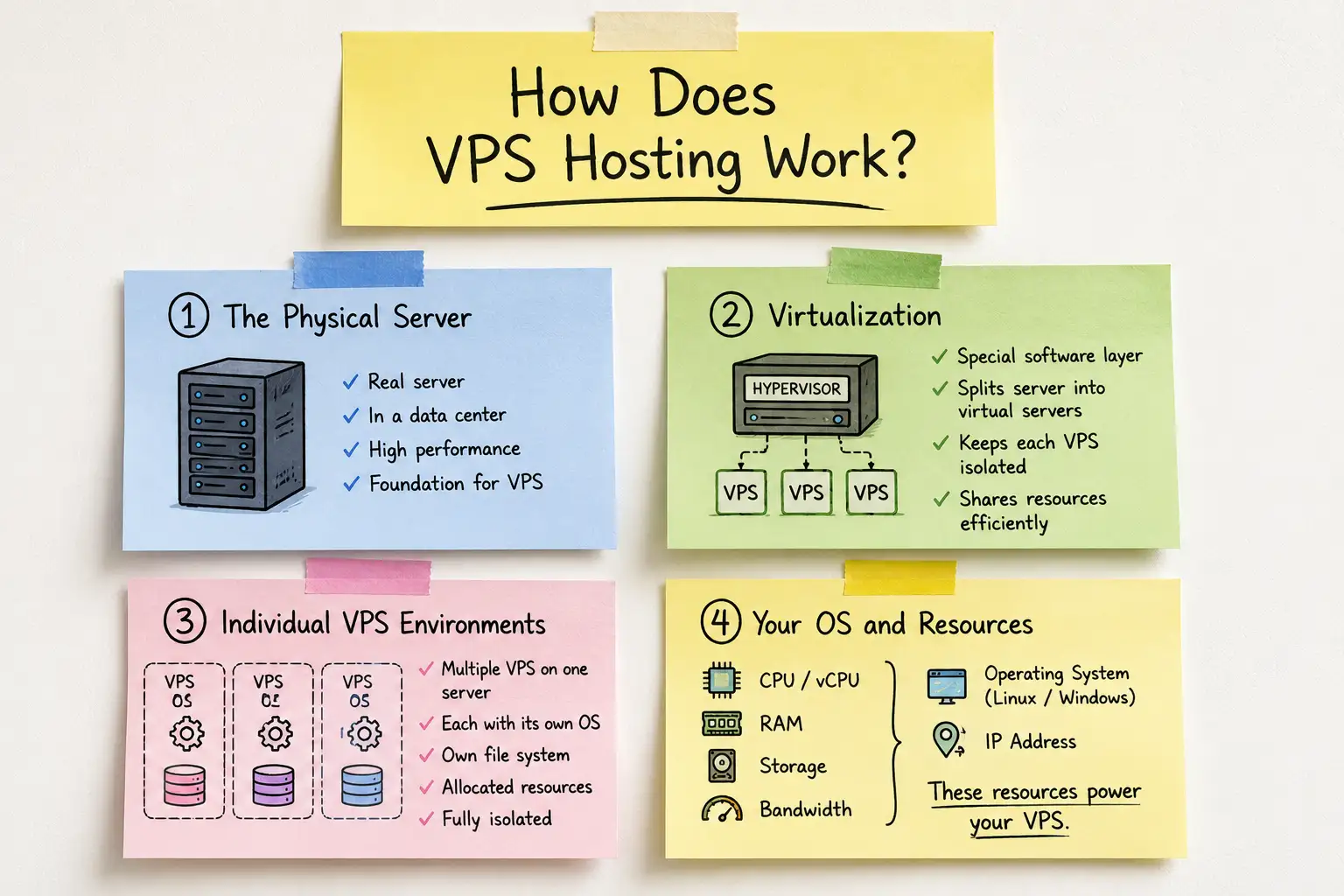
1) The Physical Server
Every VPS hosting setup begins with a physical server.
This is a real, tangible machine sitting in a data center somewhere, equipped with processors, memory chips, storage drives and network connections.
This physical server is the foundation that everything else is built on top of. Without it, there would be no VPS at all.
Data centers house these servers in secure, climate-controlled facilities designed to keep them running around the clock.
The physical server itself usually has far more processing power, memory and storage than a single website would ever need, which is exactly why it makes sense to divide its resources among multiple users.
2) Virtualization
This is where things get interesting. Virtualization is the process that allows one physical server to be split into multiple separate virtual servers.
Instead of one operating system running directly on the hardware, a special layer of software creates several isolated environments that each behave as if they were their own independent server.
The technology responsible for making this happen is called a hypervisor.
In beginner-friendly terms, a hypervisor works like a smart manager that divides the physical server’s resources fairly among all the virtual servers running on it.
It keeps each VPS separate from the others while still allowing them to share the same underlying hardware efficiently.
You do not need to know the deep technical details of how a hypervisor functions, but it helps to know that it is the reason VPS hosting is possible in the first place.
3) Individual VPS Environments
Once virtualization has done its job, multiple VPS environments can operate side by side on the same physical machine, yet remain completely separate from one another.
Each environment gets its own operating system, its own file structure and its own set of resources.
Resource allocation happens at this stage too.
A hosting provider decides how much CPU, RAM and storage each VPS is entitled to, then locks those resources in so that no VPS can eat into another one’s share.
This is the isolation that makes VPS hosting so appealing compared to shared hosting, where resource boundaries are far less defined.
4) Your Operating System and Resources
Once your VPS is up and running, you get access to a defined set of resources that determine what your server can actually do.
These typically include:
- CPU/vCPU: the processing power available to handle requests and run applications
- RAM: the memory your server uses to run processes smoothly
- Storage: the disk space allocated for your files, databases and applications
- Bandwidth: the amount of data your server can transfer to and from visitors
- Operating system: the software environment your VPS runs on, such as Linux or Windows
- IP address: a unique address that identifies your server on the internet
Together, these resources form the backbone of your VPS, and knowing what each one does is essential before choosing a plan.
What Do You Get With VPS Hosting?
When people ask what is VPS hosting really offering compared to shared hosting, the answer usually comes down to the components included in a typical plan.
While specifics vary by provider, most VPS hosting plans include the following:
- CPU/vCPU – dedicated or guaranteed processing power for your server
- RAM – memory reserved specifically for your applications and processes
- SSD or NVMe storage – fast storage drives that improve load times and overall performance
- Bandwidth – a data transfer allowance, which may be limited or unmetered depending on the plan
- Operating system – your choice of Linux distribution or Windows Server, depending on the provider
- Dedicated or assigned IP address – a unique IP that is not shared with other users
- Root/administrator access – full control over server configuration and software installation
- Server management options – ranging from fully managed to completely unmanaged setups
- Backups – some providers include automatic backups, while others offer them as an add-on
It is worth remembering that resources and features vary significantly between VPS plans.
A budget VPS plan aimed at small websites will look very different from a high-performance VPS built for a busy ecommerce store.
Before signing up, always check exactly what is included so you know precisely what you are paying for.
What Is VPS Hosting Used For?
Now that we have covered how VPS hosting works, let’s look at what people actually use it for.
The versatility of VPS hosting is one of the biggest reasons it has become so popular among businesses, developers and agencies alike.
1) Hosting Websites
The most common use case for VPS hosting is, unsurprisingly, hosting websites. This includes:
- Business websites that need more reliability and speed than shared hosting can offer
- High-traffic websites that regularly attract large numbers of visitors and require dedicated resources to stay fast and stable
- Multiple websites managed under a single account, which is common for agencies and freelancers handling several client projects
2) Ecommerce Stores
Online stores tend to outgrow shared hosting fairly quickly.
As product catalogs expand and customer traffic increases, ecommerce platforms need more processing power and memory to run smoothly.
VPS hosting suits growing online stores well, along with applications requiring more server resources, such as inventory systems, payment gateways and customer databases.
3) Web Applications
Beyond regular websites, VPS hosting is widely used to run web applications. This includes:
- Custom applications built for specific business needs
- APIs that connect different software systems and services
- Databases that store and manage large volumes of information
Because a VPS gives you root access and full configuration control, developers can install exactly the software stack their application requires, without being restricted by the limitations often found on shared hosting.
4) Development and Testing
Developers frequently use VPS hosting to create development environments where they can build and experiment without affecting a live website.
It is also useful for testing applications before they go public, and for deploying projects in a controlled setting that closely mirrors a real production server.
5) Business Software
Certain business applications and services can be hosted on a VPS where compatible, giving companies more flexibility over how their internal tools and systems are deployed and managed.
This can include everything from internal communication tools to specialized software that a business relies on daily.
6) Multiple Websites and Projects
Finally, VPS hosting is particularly useful for developers, agencies and businesses managing several websites at once.
Rather than paying for separate hosting accounts, a single VPS can be configured to host multiple sites and projects, as long as the resources allocated are sufficient to handle the combined workload.
Types of VPS Hosting
VPS hosting can be categorized in different ways, depending on the operating system, level of management and underlying infrastructure.
Knowing these categories helps when comparing plans and deciding what is VPS hosting best suited to your specific needs.
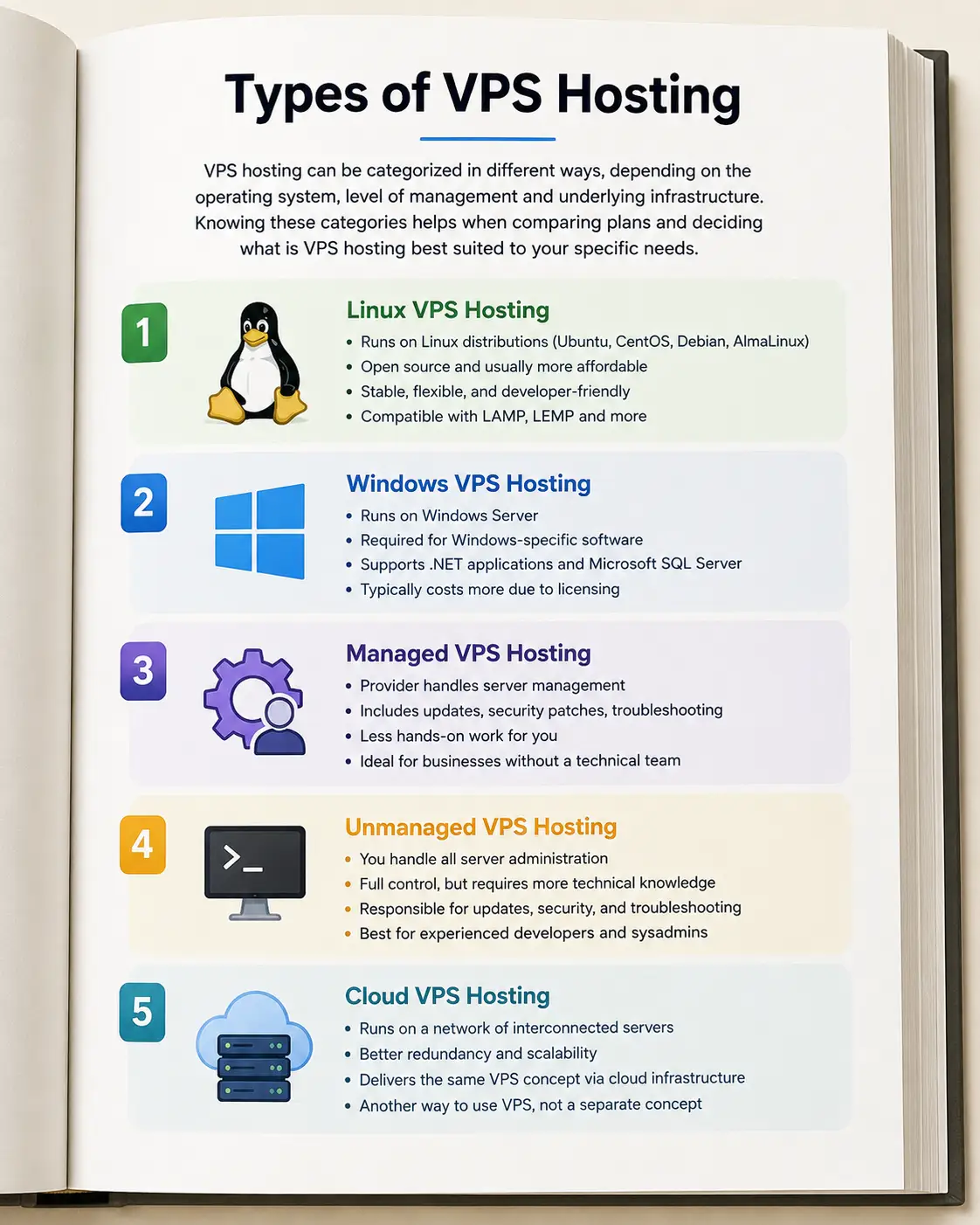
1) Linux VPS Hosting
Linux VPS hosting runs on one of many available Linux distributions, such as Ubuntu, CentOS, Debian or AlmaLinux.
Linux is open source, which usually makes it more affordable, and it is widely supported by web development communities.
Developers often choose Linux VPS hosting because of its stability, flexibility and compatibility with popular software stacks like LAMP and LEMP.
2) Windows VPS Hosting
Windows VPS hosting runs on Windows Server instead of Linux.
This option is often required when a business depends on Windows-specific software, such as applications built with the .NET framework or those requiring Microsoft SQL Server.
If your software stack relies on Windows compatibility, then Windows VPS hosting becomes the more practical choice, even though it typically comes at a higher cost due to licensing fees.
3) Managed VPS Hosting
With managed VPS hosting, the provider takes care of a significant portion of server administration on your behalf.
Depending on the plan, this can include updates, security patches, troubleshooting and other ongoing management tasks.
Managed VPS hosting is a good fit for businesses that want the benefits of a VPS without needing an in-house technical team to maintain it.
4) Unmanaged VPS Hosting
Unmanaged VPS hosting places server administration entirely in the hands of the customer.
This gives you more control, but it also requires more technical knowledge, since you are responsible for updates, security configurations and troubleshooting.
Unmanaged VPS hosting suits experienced developers and system administrators who prefer complete control over their environment.
5) Cloud VPS Hosting
Cloud infrastructure can also be used to deliver VPS environments, often referred to as cloud VPS hosting.
Rather than relying on a single physical server, cloud VPS hosting draws resources from a network of interconnected servers, which can improve redundancy and scalability.
That said, cloud VPS is not necessarily a completely separate category from VPS hosting in general.
It is simply another way of delivering the same core concept, using cloud infrastructure as the underlying foundation instead of a standalone physical machine.
Advantages of VPS Hosting
There are several reasons why so many website owners eventually move from shared hosting to VPS hosting.
Here are the main advantages worth considering.
1) Better Resource Allocation
Unlike shared hosting, where resources are pooled and often unpredictable, VPS hosting guarantees you a defined share of CPU, RAM and storage.
This means your website’s performance is not dictated by how busy other accounts on the server happen to be.
2) Greater Isolation
Since each VPS operates in its own separate environment, issues affecting one VPS rarely spill over into another.
This isolation adds a layer of stability and security that shared hosting cannot match.
3) More Control
VPS hosting gives you far more control over your server environment compared to shared hosting, allowing you to configure settings and install software according to your specific needs.
4) Root/Administrator Access
Root access means you are not limited by a hosting provider’s predefined restrictions.
You can manage your server the way you see fit, provided you are aware of the responsibilities that come with that level of access.
5) Greater Customization
From choosing your operating system to installing custom applications, VPS hosting allows for a level of customization that shared hosting simply cannot offer.
6) Improved Performance Potential
Because resources are dedicated rather than shared across many accounts, VPS hosting generally delivers better and more consistent performance, especially for busier websites and applications.
7) Easier Scalability
As your website or business grows, VPS hosting plans can usually be upgraded fairly easily, allowing you to add more CPU, RAM or storage without needing to migrate to an entirely new hosting setup.
8) Suitable for Multiple Websites and Applications
A single VPS can host multiple websites and applications simultaneously, as long as the allocated resources are sufficient, making it a cost-effective option for agencies and developers.
9) More Affordable Than Dedicated Hosting
While a VPS offers many of the benefits associated with dedicated hosting, it typically comes at a fraction of the cost, since you are still sharing the underlying physical hardware with other users, just not the resources themselves.
10) Better Security Posture
Because each VPS is walled off from the others on the same physical machine, a security issue on a neighboring account is far less likely to spread to your server.
This isolation, paired with root access to configure your own firewall and security settings, gives VPS hosting an edge over shared environments.
11) Predictable Performance
Since your resources are reserved rather than pooled with other users, a VPS tends to behave consistently even during traffic spikes elsewhere on the physical server.
This predictability makes budgeting and capacity planning much easier for growing websites.
How Much Does VPS Hosting Cost in Ghana?
For businesses and developers in Ghana, the cost of VPS hosting is often an important factor when choosing a plan.
The price you pay depends on the resources your server needs, including RAM, CPU, storage, bandwidth, and the billing period you choose.
At Truehost Ghana, we offer VPS hosting plans starting from $4.47 per month when billed for three years.
Our VPS plans are designed to accommodate different workloads, from lightweight websites and applications to more resource-intensive projects.
| VPS Plan | vCPU | RAM | Storage | Transfer | Price/month* |
|---|---|---|---|---|---|
| Cloud VPS Elite | 1 Core | 1 GB | 25 GB SSD | 1 TB | $4.47 |
| Cloud VPS 1 | 1 Core | 2 GB | 50 GB SSD | 1 TB | $6.24 |
| Cloud VPS 2 | 2 Cores | 4 GB | 100 GB SSD | 10 TB | $11.47 |
| Cloud VPS 3 | 4 Cores | 8 GB | 200 GB SSD | 25 TB | $23.08 |
Prices shown are monthly equivalents based on a three-year billing period.
The resources you need will ultimately depend on what you plan to host.
A small website or lightweight application may work well on an entry-level VPS, while an ecommerce website, database-driven application or high-traffic project may require more CPU and RAM.
So, when comparing VPS hosting prices in Ghana, don’t look at the monthly figure alone.
Consider the RAM, CPU, storage, bandwidth, support and billing period included with the plan.
The right VPS is the one that gives your website or application enough resources to run reliably without paying for capacity you don’t currently need.
How to Choose the Right VPS Hosting Plan in Ghana
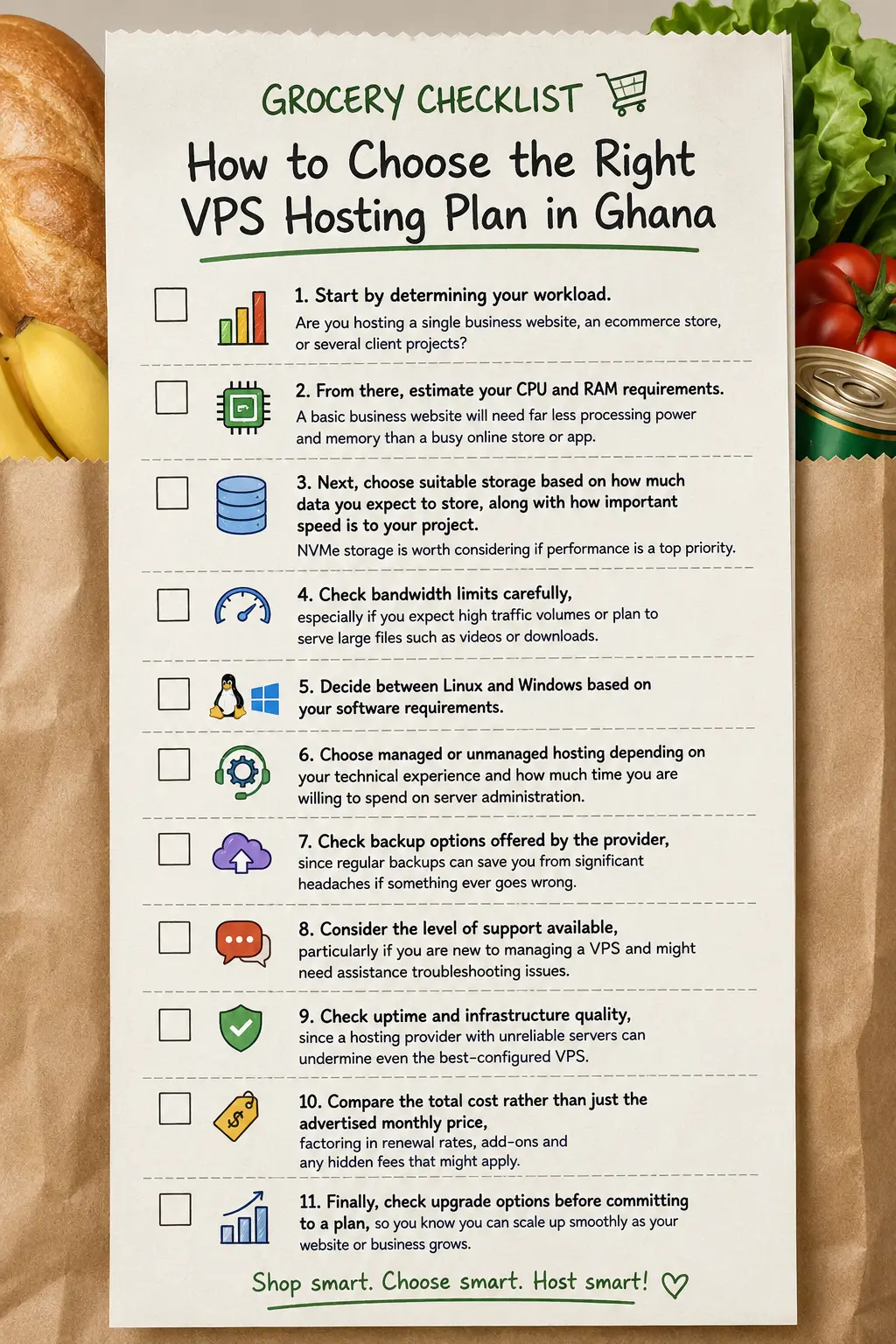
Choosing a VPS hosting plan does not have to be overwhelming if you approach it with a clear framework in mind.
Here is a practical way to work through the decision.
- Start by determining your workload.
Are you hosting a single business website, an ecommerce store, or several client projects? Your workload will heavily influence every other decision that follows.
- From there, estimate your CPU and RAM requirements.
A basic business website will need far less processing power and memory than a busy online store or a resource-heavy web application.
- Next, choose suitable storage based on how much data you expect to store, along with how important speed is to your project.
NVMe storage is worth considering if performance is a top priority.
- Check bandwidth limits carefully, especially if you expect high traffic volumes or plan to serve large files such as videos or downloads.
- Decide between Linux and Windows based on your software requirements.
If your applications depend on Windows-specific technologies, that decision is largely made for you.
Otherwise, Linux tends to be the more flexible and affordable route.
- Choose managed or unmanaged hosting depending on your technical experience and how much time you are willing to spend on server administration.
- Check backup options offered by the provider, since regular backups can save you from significant headaches if something ever goes wrong.
- Consider the level of support available, particularly if you are new to managing a VPS and might need assistance troubleshooting issues along the way.
- Check uptime and infrastructure quality, since a hosting provider with unreliable servers can undermine even the best-configured VPS.
- Compare the total cost rather than just the advertised monthly price, factoring in renewal rates, add-ons and any hidden fees that might apply.
- Finally, check upgrade options before committing to a plan, so you know you can scale up smoothly as your website or business grows, without the hassle of migrating to a completely new server later on.
Is VPS Hosting Right for You?
At its core, VPS hosting sits comfortably between shared hosting and dedicated hosting in terms of resources, control and cost.
It offers more power and flexibility than shared hosting, without the higher price tag that comes with a fully dedicated server.
The right choice ultimately depends on your workload rather than simply picking the biggest or cheapest plan available.
A small business website has very different needs compared to a growing ecommerce store or a developer managing multiple client projects, so it helps to match your VPS hosting plan to what you actually need rather than what looks impressive on paper.
For Ghanaian businesses and developers looking to scale beyond the limitations of shared hosting, VPS hosting offers a practical middle ground that balances performance, control and affordability.
Once you are ready to move beyond shared hosting, it may be worth exploring the VPS plans available through Truehost to find an option that fits your specific requirements and budget.
Frequently Asked Questions About VPS Hosting
Is VPS hosting better than shared hosting?
Generally speaking, yes. VPS hosting offers dedicated resources, greater isolation and more control compared to shared hosting, which makes it a better option for growing websites and businesses that need more reliable performance.
Is VPS hosting good for beginners?
It depends on the type of VPS hosting you choose. Managed VPS hosting can work well for beginners, since the provider handles most of the technical administration. Unmanaged VPS hosting, however, requires more technical knowledge and is better suited to experienced users.
How does VPS hosting work?
VPS hosting works by using virtualization technology to divide a single physical server into multiple isolated virtual servers, each with its own allocated resources and operating system, managed through a hypervisor.
What can you use a VPS for?
A VPS can be used for hosting websites, running ecommerce stores, developing and testing applications, managing databases, deploying business software and hosting multiple websites or projects at once.
How many websites can a VPS host?
There is no fixed limit, since it largely depends on the resources allocated to your VPS plan and the size and traffic of each website. A well-resourced VPS can comfortably host multiple websites.
Is VPS hosting secure?
VPS hosting is generally considered more secure than shared hosting because of the isolation between virtual servers. That said, security still depends heavily on how well the server is configured and maintained, particularly with unmanaged plans.
Do I need technical knowledge to use a VPS?
For unmanaged VPS hosting, yes, technical knowledge is important. For managed VPS hosting, the provider handles much of the technical side, so less expertise is required from you.
What is the difference between VPS and dedicated hosting?
VPS hosting shares a physical server among multiple virtual servers, while dedicated hosting gives you an entire physical server exclusively for your own use. Dedicated hosting offers more raw power but comes at a significantly higher cost.
Can I upgrade my VPS later?
Yes, most VPS hosting providers allow you to upgrade your plan as your needs grow, whether that means adding more RAM, CPU, storage or bandwidth.