 Domains SearchSearch available domain names and claim yours in just a few clicks.
 .GH DomainsFind and register a trusted .gh domain for your business or idea.
 Web HostingAffordable web hosting solutions designed for performance, uptime, and scalability.
 cPanel HostingManage your website without the stress. cPanel hosting gives you everything in one place.
 Reseller HostingCreate, manage, and grow your hosting clients using reliable reseller hosting tools.
 Windows HostingWindows hosting that works smoothly with Microsoft frameworks and applications.
 Email HostingProfessional email hosting that keeps your business communication reliable and secure.
 WordPress HostingFast and secure WordPress hosting optimized for smooth performance and easy management.
 Affiliate ProgramEarn commissions by referring customers to our hosting and domain services.
 .COM Domains
 All DomainsFind the right Ghana domain for your brand and lock it in fast.
 Domain TransferMove your domain to us with a smooth, secure transfer process.
 Whois LookupCheck domain ownership and registration details instantly with our WHOIS lookup.
 SSL CertificatesSecure your website and protect your visitors with trusted SSL certificates.
 VPS HostingUpgrade to VPS hosting today and enjoy better speed, uptime, and flexibility.
 Managed VPSManaged VPS for businesses and developers who want full control without server management worries.
 Dedicated ServersGet maximum speed and reliability with dedicated servers built for serious websites and apps.
 AI Website BuilderStart your website today with our AI builder and go live in minutes.
 Online ShopStart selling online today with your own professional online shop.
 Web Design ServiceProfessional web design services that make your brand stand out online.
 Local SEO
 BlogHelpful articles, tutorials, and updates for building your online presence.
 Contact UsNeed help or more information? Connect with us anytime.
VPS hosting is not one single product that works the same way for every website or business.
In reality, VPS hosting comes in several forms, and each one is built around different priorities.
Plans can differ based on operating system, level of management, underlying infrastructure, storage technology and how resources are actually provided to you.
Because of these differences, choosing the right type of VPS hosting depends on a few personal factors.
Your technical skills, the specific requirements of your application, your budget and how much control you want over your server all play a part in the decision.
Someone comfortable with server administration will look at things very differently from a small business owner who just wants a hosting plan that works without constant supervision.
In this guide, we will walk through the main types of VPS hosting available today, starting with a broad comparison before breaking each one down in detail.
By the end, you should have a much clearer picture of which option lines up best with your needs.
What Are the Different Types of VPS Hosting?
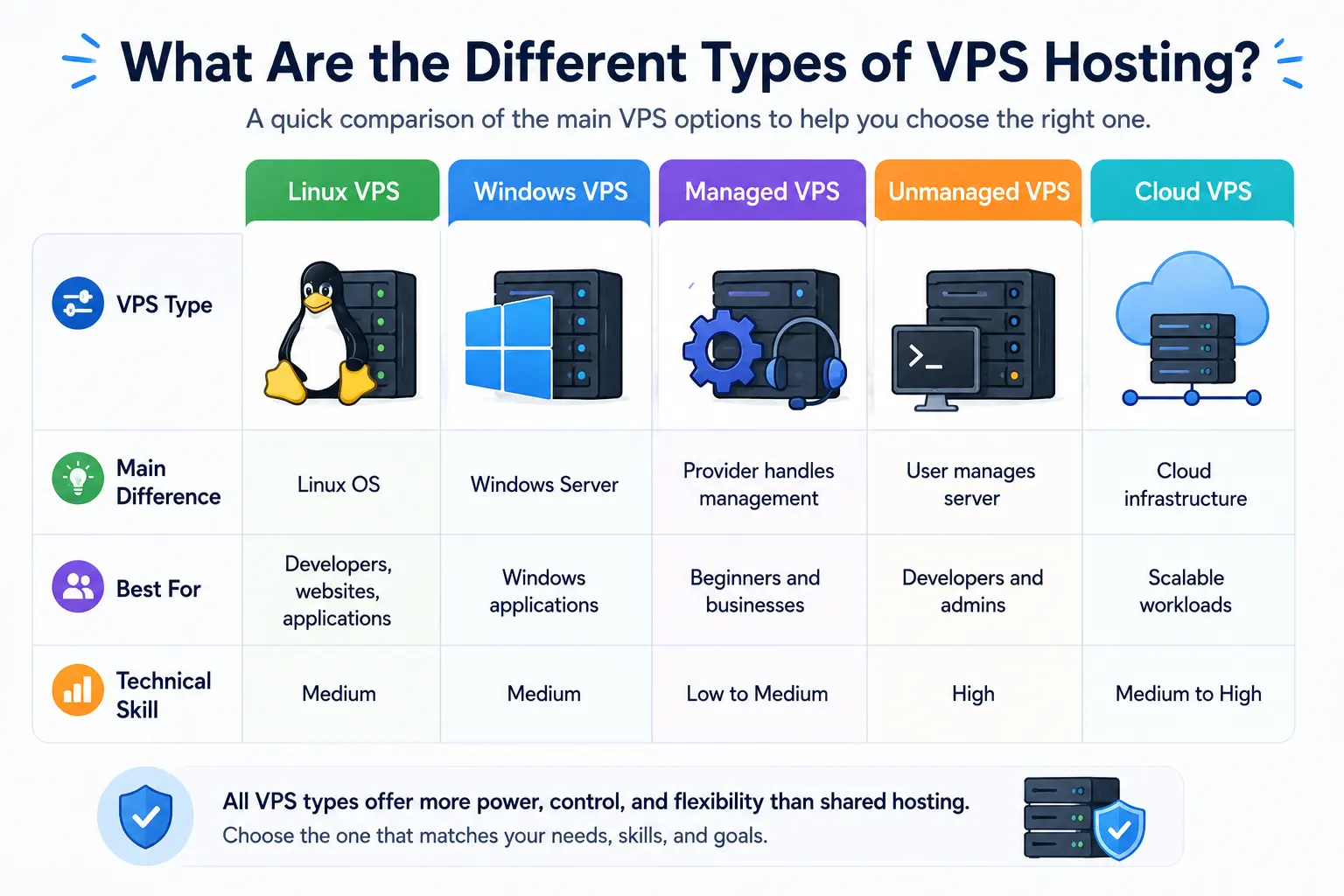
Before diving into each category, it helps to see how the main VPS options compare side by side.
The table below gives you a quick snapshot before we explore each one in more depth.
| VPS Type | Main Difference | Best For | Technical Skill |
|---|---|---|---|
| Linux VPS | Linux OS | Developers, websites, applications | Medium |
| Windows VPS | Windows Server | Windows applications | Medium |
| Managed VPS | Provider handles management | Beginners and businesses | Low to Medium |
| Unmanaged VPS | User manages server | Developers and admins | High |
| Cloud VPS | Cloud infrastructure | Scalable workloads | Medium to High |
With that overview in mind, let’s look at each type in more detail, along with who tends to benefit most from choosing it.
1) Linux VPS Hosting
Linux VPS hosting refers to a VPS running on a Linux-based operating system rather than Windows.
This is one of the most common and widely used VPS options, largely because Linux is open source, stable and backed by a massive global community of developers.
Popular Linux distributions used for VPS hosting include Ubuntu, Debian, AlmaLinux and Rocky Linux, each with its own strengths depending on the software stack you plan to run.
- Linux VPS hosting is known for its flexibility, giving users the freedom to configure their server environment almost however they like.
- It also benefits from a large software ecosystem, since most open source applications, frameworks and tools are built with Linux compatibility in mind from the start.
- Developers tend to find Linux VPS hosting particularly appealing because of its developer-friendly environment, which supports popular stacks like LAMP and LEMP without much friction.
- On top of that, Linux VPS plans often come with lower licensing costs in many cases, since there are no Microsoft licensing fees attached.
- Customization is another strong point, allowing experienced users to fine-tune nearly every aspect of the server.
Linux VPS hosting is a solid fit for developers building and deploying applications, webmasters managing content-driven sites, and businesses that want a cost-effective yet powerful hosting environment.
Agencies handling multiple client projects also gravitate toward Linux VPS hosting, along with users running any application that is specifically built for Linux compatibility.
2) Windows VPS Hosting
Windows VPS hosting is exactly what it sounds like: a VPS running Windows Server instead of Linux.
This type of VPS hosting is aimed at users whose software or applications depend specifically on the Windows environment.
- The biggest draw of Windows VPS hosting is the familiar Windows environment it provides, which appeals to users who are more comfortable navigating a Windows-style interface rather than a command line.
- It also offers compatibility with Windows-specific applications, including software built on the .NET framework or tools that rely on Microsoft SQL Server.
- Windows VPS hosting typically includes Remote Desktop access, allowing you to connect to your server through a graphical interface rather than working purely through terminal commands.
- It also provides support for certain Microsoft technologies that simply are not available or well supported on Linux.
Windows VPS hosting makes the most sense for businesses requiring Windows applications to run their operations, along with developers working with Windows-specific technologies.
It is also the right choice for users who specifically need Windows Server for compliance, compatibility or software licensing reasons.
3) Managed VPS Hosting
Managed VPS hosting is one of the more beginner-friendly options on this list, since the provider handles some or much of the server administration on your behalf.
It is worth noting that exactly what is managed varies quite a bit from provider to provider, so it always pays to check the specifics of a plan before signing up.
Managed VPS hosting plans can include:
- Server setup so you do not have to configure everything from scratch, along with regular updates to keep your software current.
- Security configuration is often handled by the provider too, alongside ongoing monitoring to catch issues before they become serious problems.
- Troubleshooting support is another common inclusion, along with backups, depending on the specific plan you choose.
- Many managed VPS hosting plans also offer control panel assistance, helping you navigate tools like cPanel or Plesk without needing deep technical knowledge.
Managed VPS hosting is best suited to beginners who are new to server administration, along with small businesses that would rather focus on running their operations than maintaining a server.
Website owners without a technical background often prefer this route too, as do businesses without dedicated server administrators on staff.
The main benefits of managed VPS hosting are less technical work on your end, access to provider support when things go wrong, and generally easier day-to-day administration.
On the other hand, the limitations include a higher cost compared to unmanaged plans, along with potentially less hands-on control, since the provider is handling parts of the server you might otherwise want to configure yourself.
4) Unmanaged VPS Hosting
Unmanaged VPS hosting sits on the opposite end of the spectrum, where the customer is fully responsible for server administration from start to finish.
With unmanaged VPS hosting, you take on responsibility for operating system updates, installing any software your applications require, and configuring security settings to protect your server.
You are also responsible for setting up and maintaining your firewall, along with ongoing server optimization to keep performance consistent.
Application deployment falls entirely on you as well, meaning you will need to know how to get your software running correctly on the server.
Troubleshooting is also part of the package, so when something breaks, fixing it is your responsibility rather than the provider’s.
This type of VPS hosting is best suited to developers who are comfortable working directly with server environments, along with system administrators who already manage infrastructure as part of their role.
Technically experienced users who want full control, without paying extra for management they do not need, also tend to lean toward unmanaged VPS hosting.
5) Cloud VPS Hosting
Cloud VPS hosting refers to VPS environments delivered using cloud infrastructure rather than relying entirely on a single standalone physical server.
It is worth being careful here, since cloud does not automatically mean unlimited resources.
A cloud VPS still operates within defined resource limits based on the plan you choose, even though the underlying infrastructure works a little differently.
How Does Cloud VPS Differ From Traditional VPS?
The biggest difference comes down to infrastructure.
Traditional VPS hosting typically runs on a single physical server, while cloud VPS hosting draws from a network of interconnected servers working together.
This can affect scalability, since cloud VPS hosting often makes it easier to adjust resources on demand compared to a more fixed traditional setup.
Resource allocation can also work a bit differently, along with availability, since cloud infrastructure is often designed with built-in redundancy to reduce downtime if one server in the network experiences an issue.
Deployment tends to be faster with cloud VPS hosting too, since new instances can often be spun up quickly through automated systems.
Pricing structures can vary as well, with some cloud VPS plans offering more flexible, usage-based billing compared to fixed monthly rates.
Who Should Use a Cloud VPS?
Cloud VPS hosting works well for growing applications that may need to scale quickly, along with businesses needing flexible infrastructure that can adapt to changing demand.
Developers building projects with unpredictable traffic patterns often prefer cloud VPS hosting too, as it suits workloads that may need scaling without a lengthy migration process.
VPS Types Based on Virtualization Technology
Beyond the categories already covered, there is a more technical way to classify a VPS, based on the virtualization technology used behind the scenes.
While this classification is a little more advanced, it genuinely helps to know how your VPS actually behaves under the hood.
a) KVM VPS
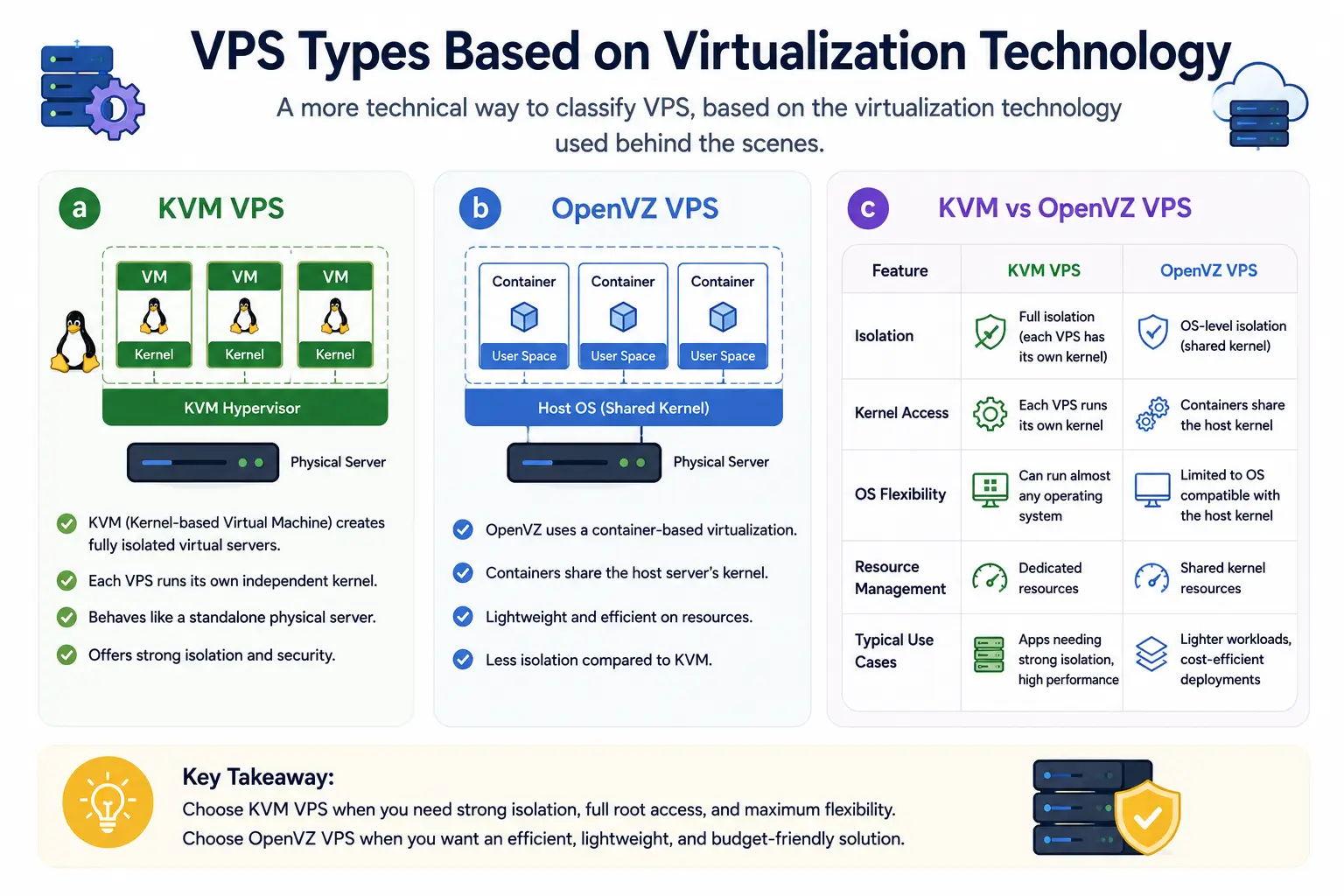
KVM, short for Kernel-based Virtual Machine, is a virtualization method that creates fully isolated virtual servers, each capable of running its own independent kernel.
Because of this, a KVM VPS behaves much like a standalone physical server, offering greater virtualization isolation than some alternative approaches.
This makes KVM a popular choice for users who need strong separation between their VPS and others sharing the same physical hardware.
b) OpenVZ VPS
OpenVZ takes a different approach, relying on a container-based method rather than full virtualization.
Instead of running a separate kernel for each VPS, OpenVZ containers share the host server’s kernel while still keeping individual environments logically separated.
This container-based structure tends to be lighter on resources, though it comes with certain resource-sharing characteristics that set it apart from the full isolation offered by KVM.
Since containers share a kernel, OpenVZ is fundamentally different from full virtualization technologies.
c) KVM vs OpenVZ VPS
When comparing these two virtualization types, isolation is one of the clearest differences, with KVM offering more complete separation compared to the shared-kernel approach used by OpenVZ.
Kernel access is another point of contrast, since KVM allows each VPS to run its own kernel, while OpenVZ containers rely on the host kernel instead.
Operating system flexibility tends to favor KVM as well, since it can run a wider range of operating systems independently.
Resource management also differs slightly between the two, along with typical use cases, since KVM is often favored for workloads requiring stronger isolation, while OpenVZ can suit lighter, more cost-efficient deployments.
Which Type of VPS Hosting Should You Choose?
After going through all these options, it should be clear that there is not one universally best type of VPS hosting.
The right choice depends entirely on your specific situation rather than a single standard recommendation that fits everyone.
Before making a final decision, take the time to evaluate your actual workload, the resources it demands and the level of management you genuinely want, rather than choosing based on price alone or what sounds most impressive.
The types of VPS hosting covered in this guide each serve a different purpose, and the best plan is simply the one that lines up with what you actually need.
Once you have a clearer picture of the type of VPS hosting that fits your project, Truehost offers a range of VPS plans built to support businesses and developers at every stage, making it easy to find an option that matches your workload and budget.